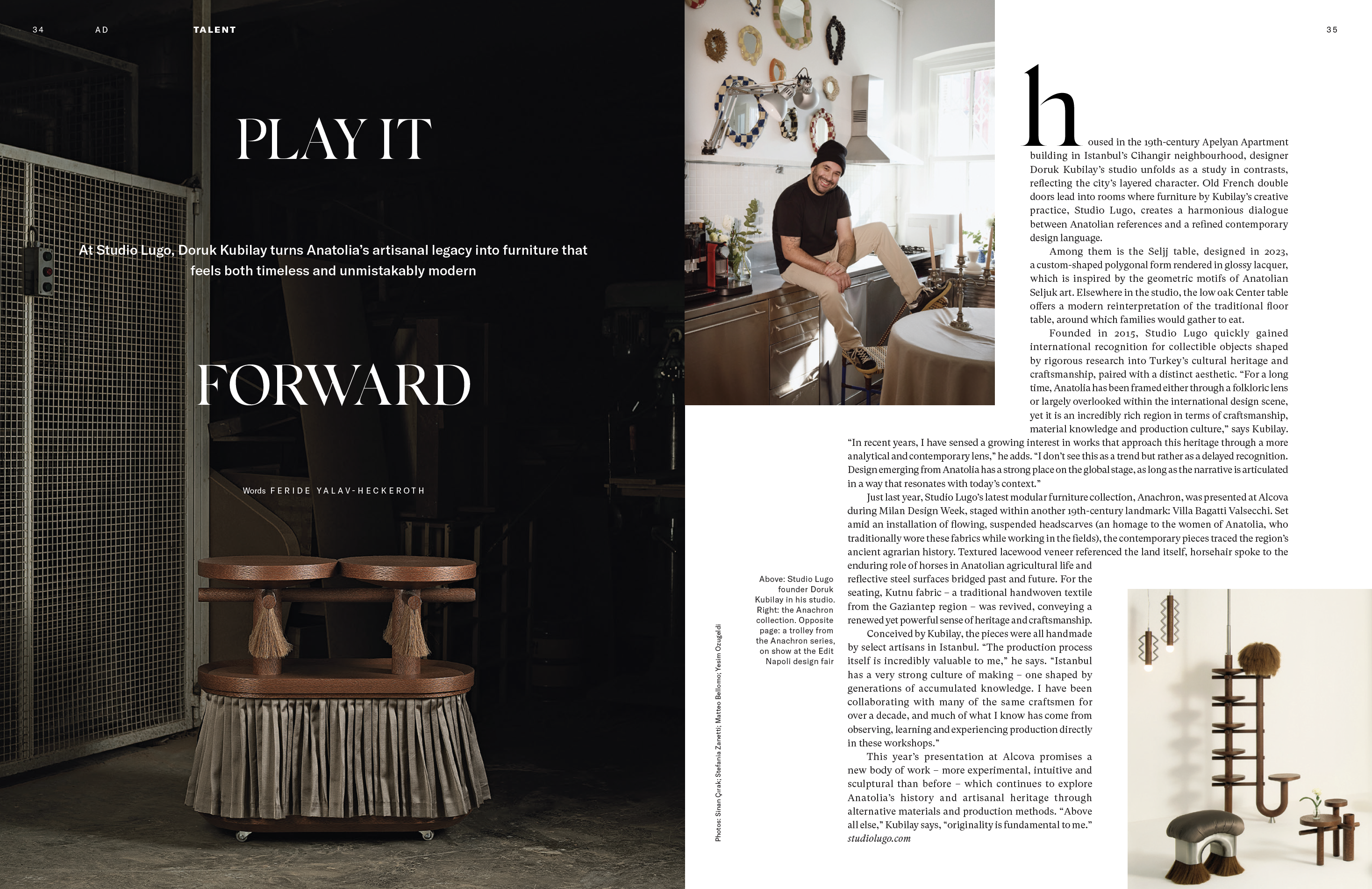
Inside the 19th century Apelyan Apartment in Istanbul’s Cihangir neighborhood, the studio of Doruk Kubilay is a classic juxtaposition of old and new, which also happens to define this Turkish metropolis of opposites. The old French double doors open to rooms where pieces from Studio Lugo’s furniture collections emanate harmony between their Anatolian inspirations and clearly contemporary intentions. The Seljj Table is there, from 2023, a custom-shaped polygonal glossy lacquered table inspired by the geometric elements of Anatolian Seljuk art. And over there, the Center Low from 2020, a low table composed of oak, is a modern reinterpretation of the traditional Anatolian floor table where families gather to eat.
Founded in 2015 by Kubilay, Studio Lugo quickly took its place in the international design scene, with collectible objects born from deep research into Turkey’s rich cultural heritage and craftsmanship, yet with a distinct aesthetic. “For a long time, Anatolia has either been framed through a folkloric lens or largely overlooked within the international design scene, yet it is an incredibly rich region in terms of craftsmanship, material knowledge, and production culture,” says Kubilay. “In recent years, I sense a growing interest in works that approach this heritage through a more analytical and contemporary lens. I don’t see this as a trend, but rather as a delayed recognition. Design emerging from Anatolia has a strong place on the global stage, as long as the narrative is articulated in a way that resonates with today’s context.”
Just last year, Studio Lugo’s latest Anachron modular furniture collection was showcased at Alcova during Milan Design Week, inside another 19th century beauty: the Villa Bagatti Valsecchi.Amongst an installation of flowing headscarves suspended from the ceiling–inspired by the hardworking women of Anatolia who traditionally wore these fabrics while working in the fields–the contemporary pieces recounted Anatolia’s ancient agrarian history. Highly textured lacewood veneer was used to refer to the land itself, horsehair to mark the importance of the horse in Anatolia’s agricultural life, and reflective steel surfaces to fuse past and future. For the seating pieces, Kutnu fabric– a traditional handwoven textile produced in the Gaziantep region–was revived, exuding, anew, a strong sense of heritage and handcraft.
Dreamed up by Kubilay, the pieces were all handmade by select Istanbul craftsmen. “The production process itself is incredibly valuable to me. Istanbul has a very strong culture of making — one shaped by generations of accumulated knowledge,” says Kubilay. “I have been collaborating with many of the same craftsmen for over a decade, and much of what I know has come from observing, learning, and experiencing production directly in the workshops.”
For Milan Design Week’s Alcova 2026, Studio Lugo promises a completely new body of work, even more experimental, intuitive, and sculptural, but still possessing its love for the artisanal, for history, and the harmony of alternative materials and production methods. “Above all else, originality is fundamental to me,” says Kubilay.
Architectural Digest Middle East, February-March 2026
 Feride Yalav-Heckeroth