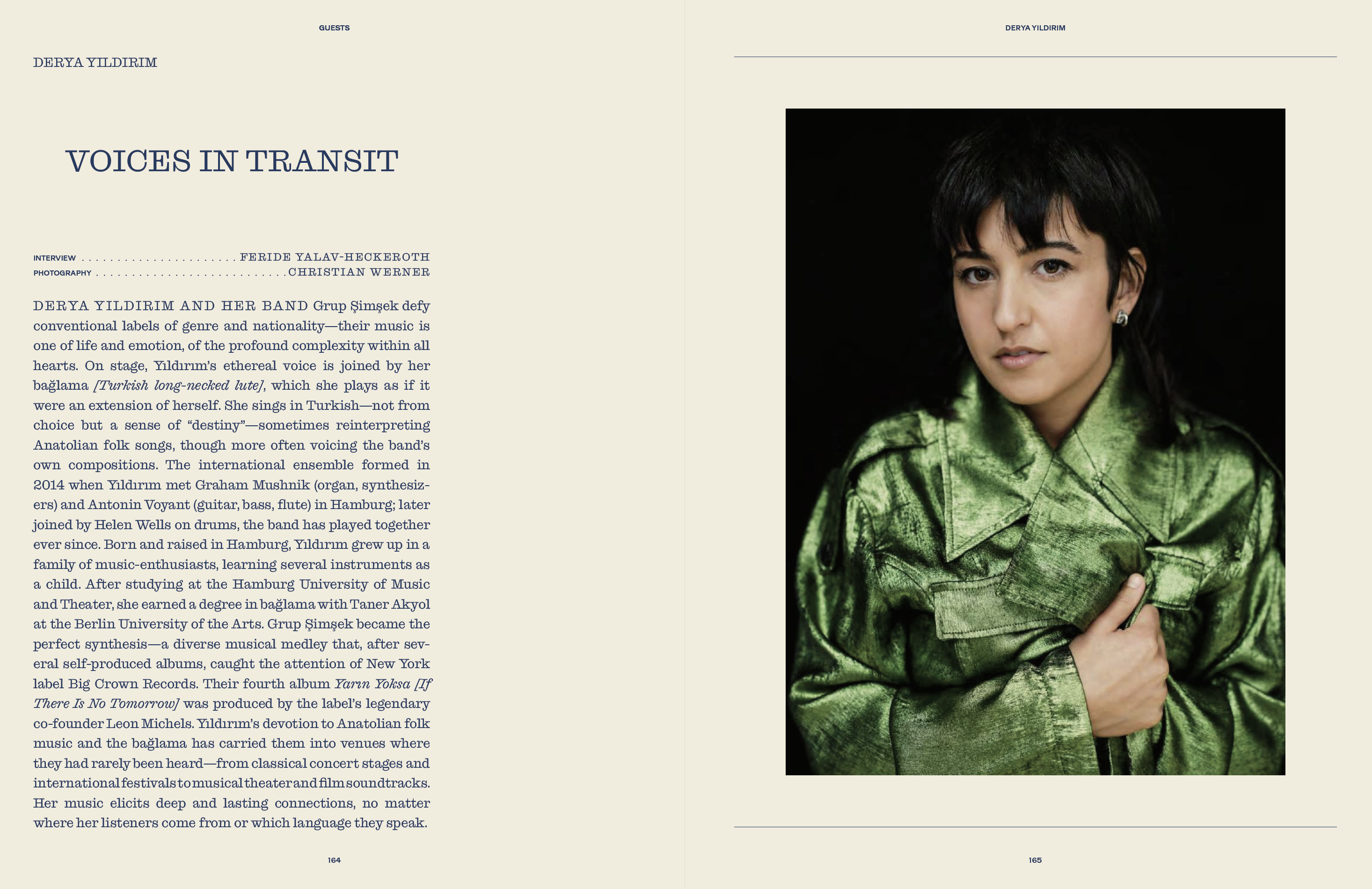
Derya Yıldırım for TTA

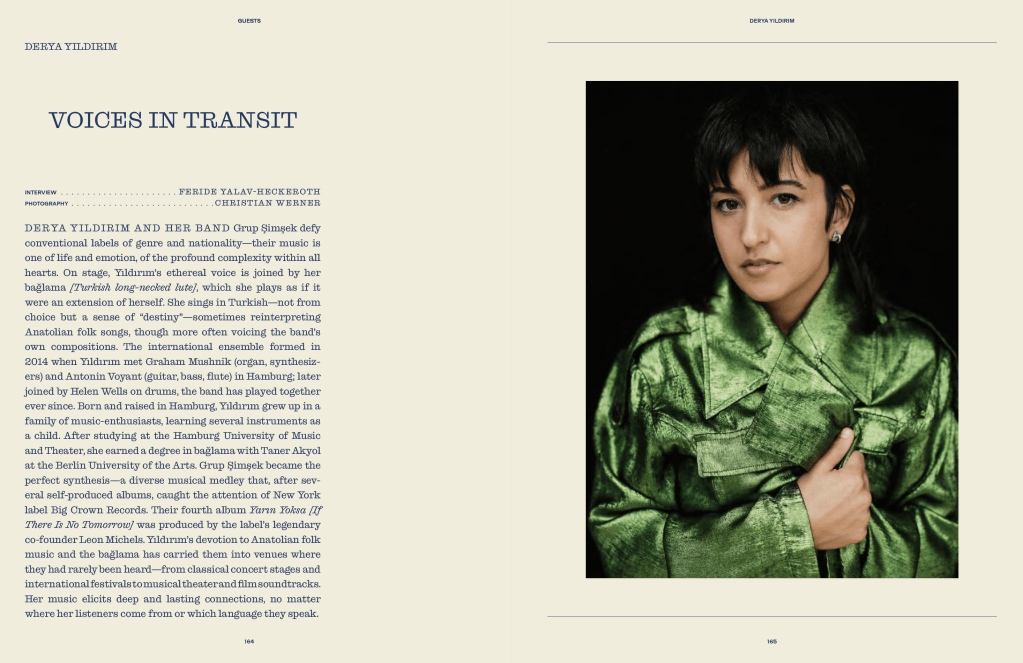
Derya Yıldırım and her band Grup Şimşek defy conventional labels of genre and nationality, for theirs is a music of life and emotion—of the profound complexity within all our hearts. On stage, Yıldırım’s ethereal voice is accompanied by her bağlama [Turkish long-necked lute] which she plays as if it were an extension of her body. She sings in Turkish—not out of volition but a sense of “destiny”—sometimes reinterpreting Anatolian folk songs, though more often giving voice to the band’s own compositions. The international ensemble formed in 2014 when Yıldırım met Graham Mushnik (organ, synthesizers) and Antonin Voyant (guitar, bass, flute) in Hamburg. Later joined by Helen Wells on drums, the band has been playing together ever since.

Born and raised in the North-German city of Hamburg, Yıldırım grew up in a family of music-enthusiasts, learning to play several instruments as a child. After studying at the Hamburg University of Music and Theater, she pursued a degree in bağlama with Taner Akyol at the Berlin University of the Arts. The formation of Grup Şimşek became the perfect synthesis—a diverse musical medley which, after several self-produced albums, caught the attention of the New York label Big Crown Records. The band’s fourth album Yarın Yoksa [If There is No Tomorrow] was produced by the record’s legendary co-founder Leon Michels. 

As a solo artist, Yıldırım’s devotion to Anatolian folk music and the bağlama, especially in new contexts, has allowed her to carry them into venues where they had rarely been represented previously. From classical concert stages and international festivals to musical theater and film soundtracks, Yıldırım’s music has the capacity to elicit deep and lasting connections, no matter where her audience members hail from or which language they speak. 

Too bad we couldn’t meet up in person when I was in Berlin.

I’m still sick, can you believe it? I can’t get rid of this pesky cough. I was really looking forward to meeting you. The worst part is that I had an accident yesterday.

What? Are you alright? Can I ask what happened?

I was on my way to Bremen for a concert; I was actually supposed to be in Belgium today. I was in a taxi and the driver had an accident. It was really bad, another car drove into us from the right side, which is where I was sitting. It’s really a miracle that nothing happened to me. The car was totaled. My bağlama literally split in half.

I’m so sorry, we can postpone if you want.

No, it’s fine. I’m ok.

I’m going to be very Turkish right now and say, Nazar değmiş [the evil eye brought you bad luck]. Do you believe in those little superstitions we have in our culture? In Nazar and Hayır [fate], or do you feel like you make your own choices?

To be honest, I’m always the one in the band who looks for meaning when things like this happen. Because I don’t believe in coincidences—I always have to find meaning. Maybe because of this accident, I was protected from something much worse. I think I’m influenced by Turkish superstitions, but I definitely want to create my own world, invent my own meaning in it. I’m not that religious either and I see culture as something that is constantly changing.

I think your music reflects this sentiment as well. It’s influenced by many things, so to say that you’re simply a Turkish band would be too reductive. How would you describe your music?   

I grew up in a family of music enthusiasts. My father always played the bağlama at home, as well as the guitar. I was very influenced by him because he was the first person I made music with and learned from. I simply grew up with this culture where Turkish folk music played an essential role in my life, even though I grew up in Hamburg. And this showed me that even though Anatolian music has its roots in Anatolia, it can also exist and thrive somewhere else. I am living proof of that.  

This music has always been a part of me, but everything I do is a snapshot of our time. I wanted to invent a new language that reflects our generation, especially my position as an individual in Germany. I always say, “Grup Şimşek is not a Turkish band, damn it!” We are just four people who somehow came together in Hamburg and made music. We ended up liking each other so much that we toured together and somehow people liked our music and suddenly we had real fans in Europe. It was a very organic process; the music is very much a part of all of us. When we reinterpret old songs, we only do it because we believe that we can create a vision that should belong to this world, that will bring something more interesting into it. We don’t refer to one particular nation because this music is based on the experiences of each individual band member. The music speaks for itself.

And it’s not just Europe anymore either. How have things changed since signing with a label based in New York?

With the new album, so many new doors have opened and the music is finding even more resonance. Everyone in New York is so interested, and it’s pretty crazy how they just flew us there to record for two weeks with Leon Michels. What’s happening is very intense, how Anatolian music is finding its place, how it can exist anywhere—all that was missing was the right people to carry it forward. I think with the new album we can reach a different audience since the production is completely different. For example, my mother video-called me the other day because she heard one of our songs whilst shopping at H&M. I mean, our songs are now part of the H&M playlist?! I’ve never heard music of Turkish origin at an H&M in Germany before—have you? It’s kind of funny, but it has something to do with the new album. We’re now in the market that basically dominates the world. I mean, I’m not a fan of capitalism, but I think it’s great that Anatolian music is now somewhere else entirely. I’m really proud of it, actually.

I think it’s also fascinating how your music resonates so vastly, even though most people don’t understand the lyrics, which are in Turkish.

I notice again and again, especially now that we’re also present in America, that language is not a barrier for us. The music transmits so much, even without people understanding the language. I think that’s a blessing, maybe even a gift. I also think that my singing is definitely a key part of this as singing is a person’s first instrument. I believe that everyone has music within them, simply because our hearts already have their own rhythm. It goes straight to the heart—since everyone has a voice, everyone can sing. I notice how touched our audiences are. Our concerts are always very emotional. There are moments when we cry and moments when we all dance and have fun. It’s all up and down. When hearts are open, we can have a beautiful exchange. I feel that, every time.

That sounds beautiful. Are there any cities in particular where you love to play?

Of course, Berlin is a city where we really have a great time on stage. Hamburg too, because that’s where we were “born” as a band. Another place is London, because half of the band lived there for 10 years and have lots of friends there, and we’ve always had very sincere encounters with people there. What’s very special for us is playing in Istanbul. That happens very rarely—once a year maybe. Last year we had our first tour in Turkey, including in Ankara and Izmir. It’s a unique experience because we represent something in the world, and yet when we go to Turkey it somehow feels different. You’re suddenly in the country where everything originated, and it’s kind of weird. But I feel like part of the crowd when I’m there. It makes me so happy to be in my world, in my thoughts, and just one of many—it’s nice that I don’t stick out, that everyone is somehow similar to me, it makes me happy to be normal. And when you’re on stage you know that people understand the lyrics and that makes it special for me. This extra level, which the language brings, can really blossom in Turkey.

Do you think you made a conscious choice to sing in Turkish?

Well, I’m Turkish, my parents are Turkish, and I grew up speaking Turkish. But it’s more than that. I never decided to sing in Turkish, it’s just my destiny. What other language could I sing in? I can’t sing in German. 

Okay, so definitely Turkish! You grew up in Hamburg. Are you still connected to your hometown?

I feel very much at home in Hamburg and still have very close ties to the institutions there. They all have me on their radar and I continue to be involved with them. I’m very proud of that. You can now study bağlama at the Hamburg University of Music and Theater. We’ve already had the first meeting with the dean and president, and I was so flattered that they chose me and not another musician. Hamburg is a very special city. They look after themselves and their people. I’m also with Ensemble Resonanz at the Elbphilharmonie—a string ensemble from Hamburg that I’ve been working with for 10 years now—and we performed together for our album-release concert.

What about Berlin, where you live now, are there any particular places you have a special connection with? 

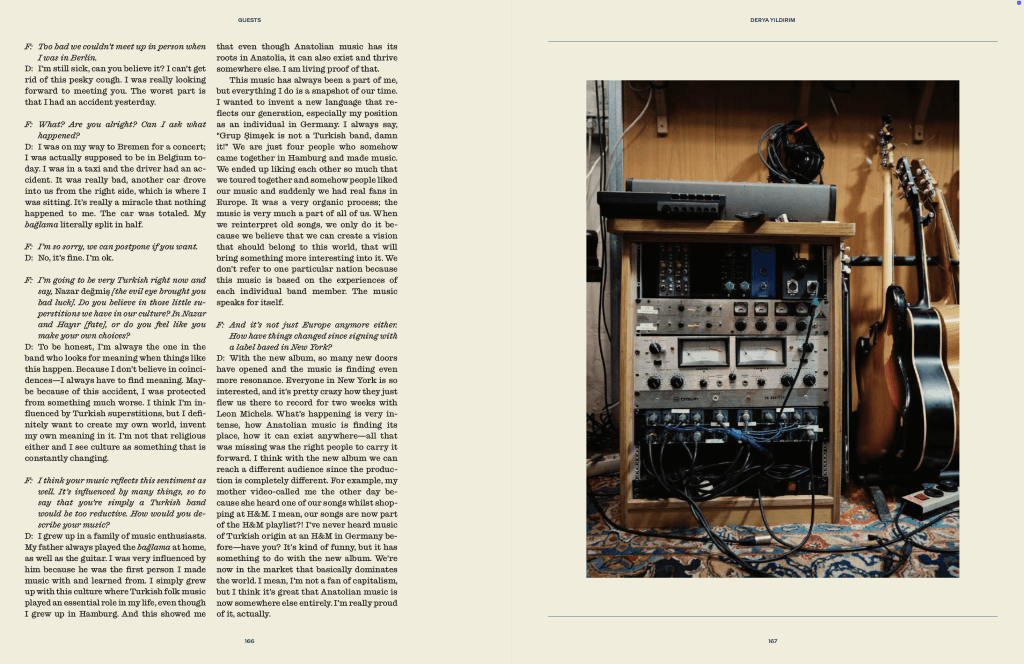
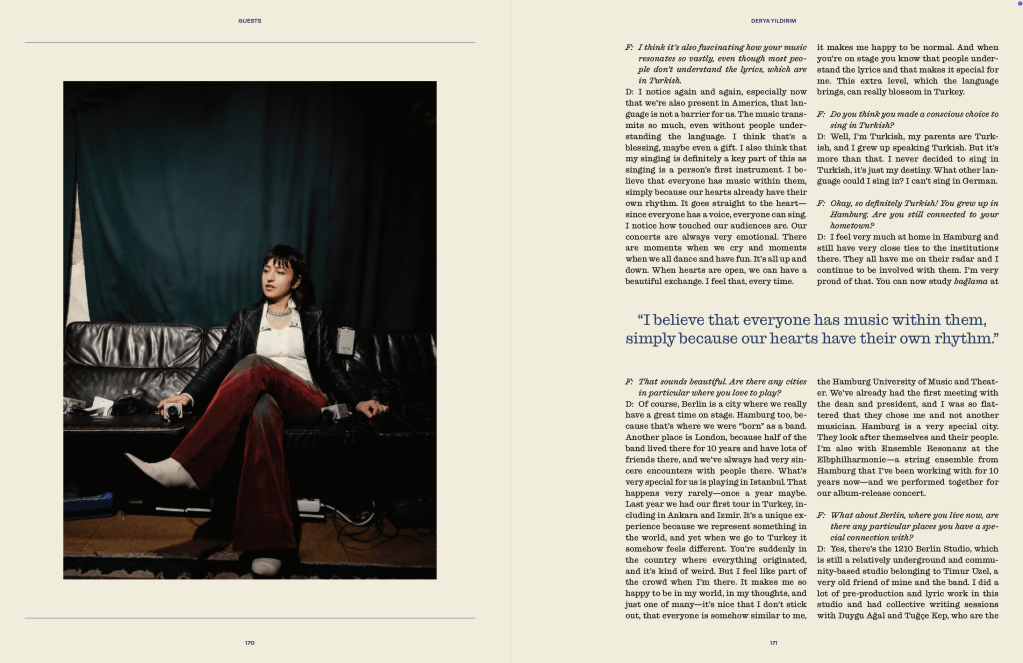
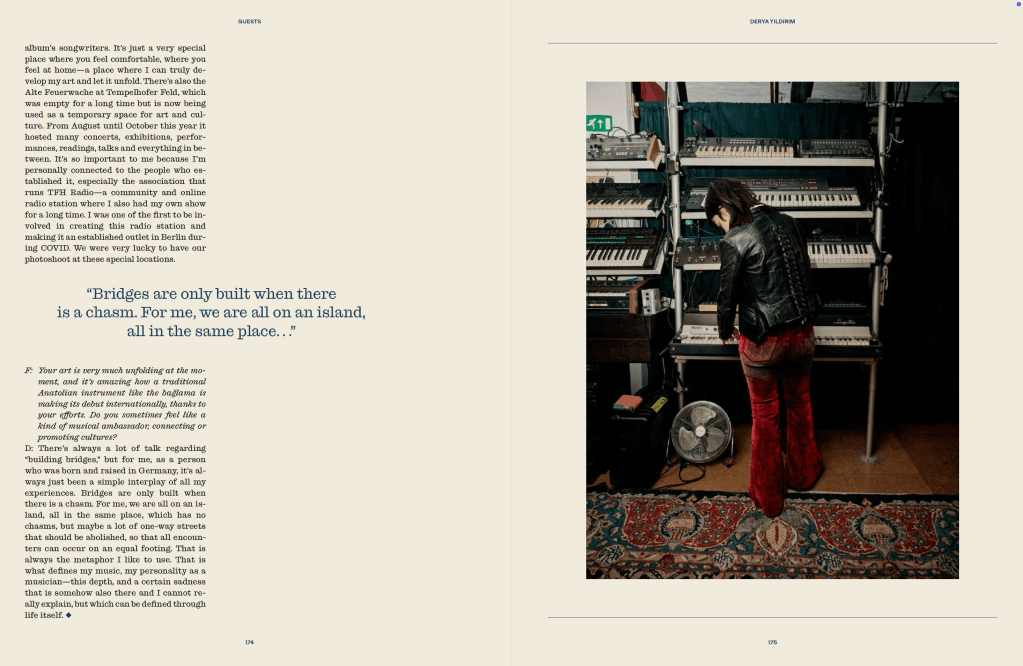
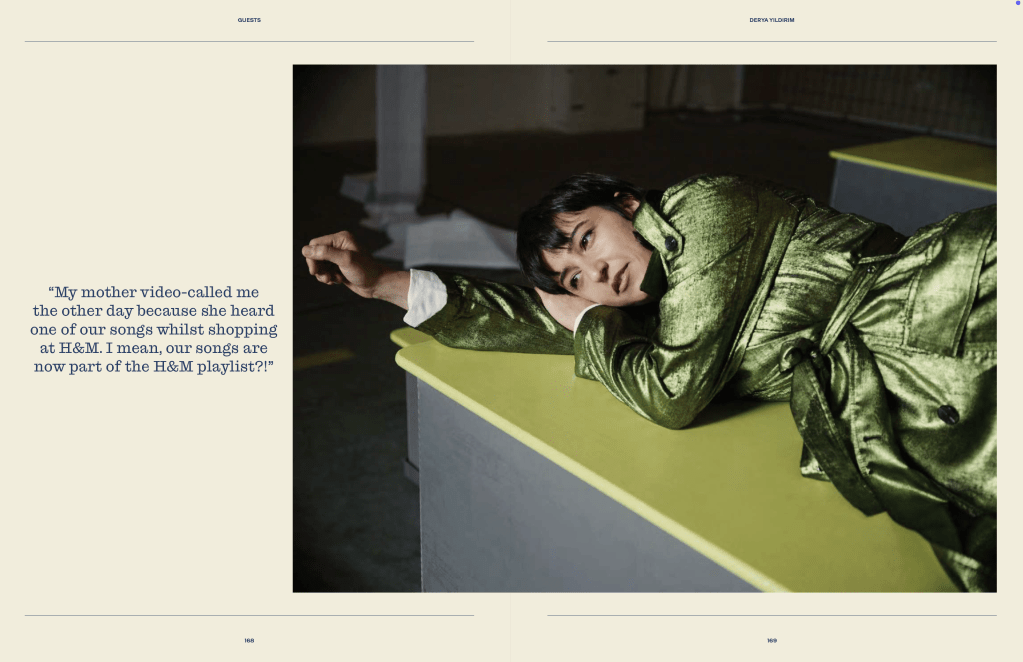
Yes, there’s the 1210 Berlin Studio, which is still a relatively underground and community-based studio belonging to Timur Uzel, a very old friend of mine and the band. I did a lot of pre-production and lyric work in this studio and had collective writing sessions with Duygu Ağal and Tuğçe Kep, who are the album’s songwriters. It’s just a very special place where you feel comfortable, where you feel at home—a place where I can truly develop my art and let it unfold. There’s also the Alte Feuerwache at Tempelhofer Feld, which was empty for a long time but is now being used as a temporary space for art and culture. From August until October this year it hosted many concerts, exhibitions, performances, readings, talks and everything in between. It’s so important to me because I’m personally connected to the people who established it, especially the association that runs TFH Radio—a community and online radio station where I also had my own show for a long time. I was one of the first to be involved in creating this radio station and making it an established outlet in Berlin during COVID. We were very lucky to have our photoshoot at these special locations. 

Your art is very much unfolding at the moment, and it’s amazing how a traditional Anatolian instrument like the bağlama is making its debut internationally, thanks to your efforts. Do you sometimes feel like a kind of musical ambassador, connecting cultures? 

There’s always a lot of talk regarding “building bridges,” but for me, as a person who was born and raised in Germany, it’s always just been a simple interplay of all my experiences. Bridges are only built when there is a chasm. For me, we are all on an island, all in the same place, which has no chasms, but maybe a lot of one-way streets that should be abolished, so that all encounters can occur on an equal footing. That is always the metaphor I like to use. That is what defines my music, my personality as a musician—this depth, and a certain sadness that is somehow also there and I cannot really explain, but which can be defined through life itself.

The Travel Almanac, TTA27 The Advent
Leave a comment