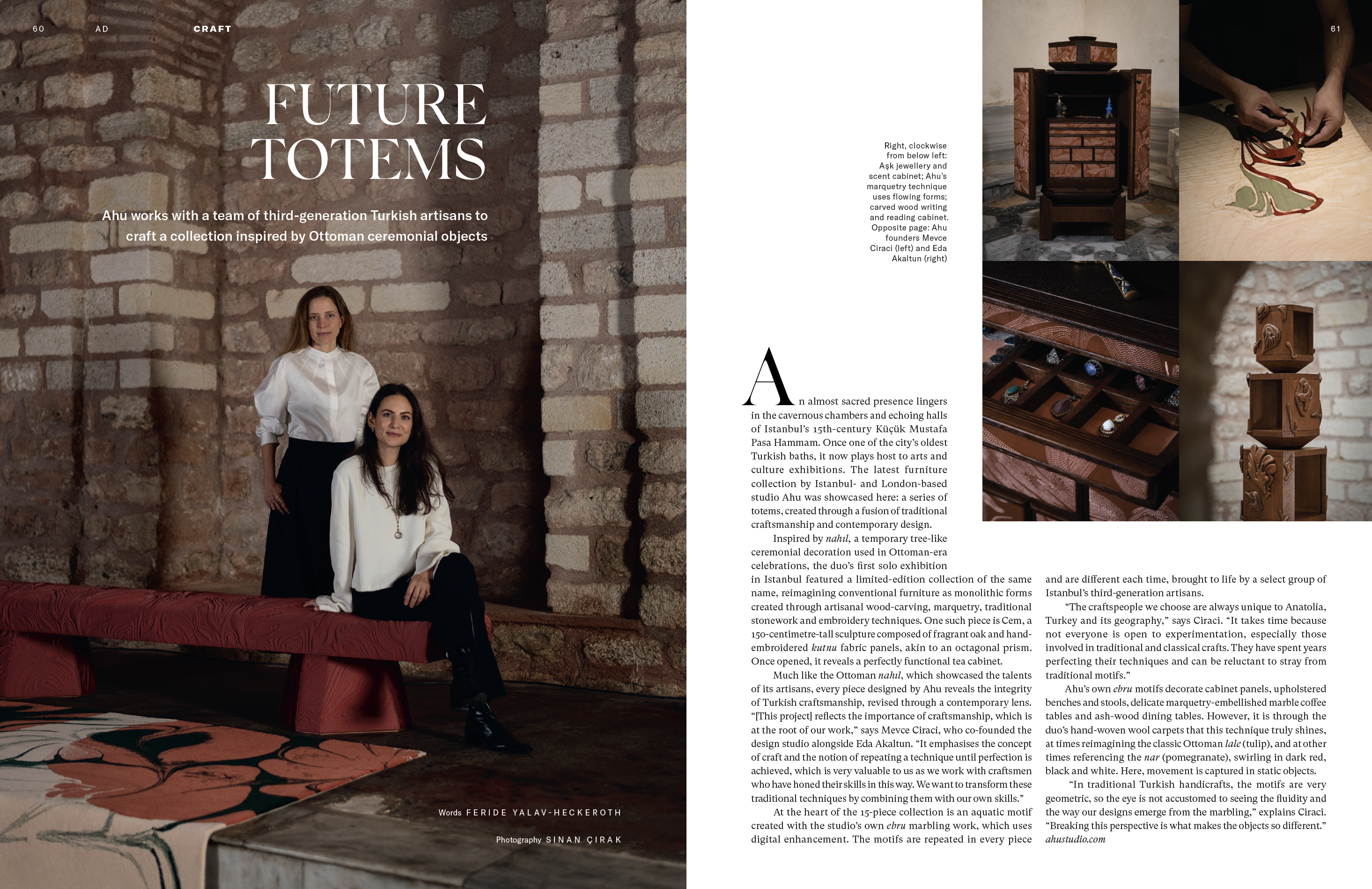
There’s an almost sacral feeling present in the cavernous chambers and echoing domed halls of the 15th century Küçük Mustafa Pasa Hammam exhibition space. Positioned in geometric unity, the latest furniture collection by the Istanbul and London based Ahu Studio appears like totems that incite worship for the minute beauty created through the fusion of traditional craftsmanship and contemporary design and function.
Inspired by nahıl–a temporary and towering ceremonial tree-like decoration used in Ottoman-era celebrations–the solo exhibition of the limited-edition collection reimagines conventional furniture as monolithic forms created through artisan wood carving, marquetry, stonework, and embroidery techniques. One of the pieces, entitled Cem–standing 150 centimeters tall and composed of fragrant oak and hand-embroidered kutnu fabric panels–is, for example, akin to an octagon prism-like sculpture. Yet when its doors and lower drawer are opened, its hidden purpose as a perfectly functional tea cabinet, is revealed.
Much like the Ottoman nahıl, which showcased the talents of its artisans, every Ahu piece exhibits the integrity of a specific form of Turkish craftsmanship, updated with Ahu’s contemporary perspective and design. “[The theme of nahıl]reflects the importance we place on craftsmanship, which is at the root of our work,” says Mevce Ciraci, who co-founded Ahu Studio alongside Eda Akaltun. “It emphasizes the importance of the concept of craft and the idea of repeating a technique until perfection is achieved. It is very valuable to us because we work with craftsmen who have improved themselves in this way, and we want to change and transform old techniques by combining them with our skills.”
Apart from the furniture design itself, the heart of the 15-piece collection also lies in the flowing almost aquatic motifs created by the studio’s own ebru marbling work and its digital enhancement. The ebru motifs are repeated in every piece but are different every time, brought to life by a select group of Istanbul’s third-generation artisans. “The craftspeople we choose are always unique to Anatolia, to Turkey and its geography. It takes time, because not everyone is open to experimentation, especially those involved in very traditional and classical crafts who have spent years perfecting them and are reluctant to stray from that motif,” says Ciraci.
Ahu’s ebru motifs are smooth in their renditions as decorative cabinet panela, as embroidered upholstered bench and stools, as delicate marquetry embedded into marble coffee tables or an ash wood dining table. In their three-dimensional renditions, the ebru designs appear more palpable as wrap embroidered panels, carved wooden objects attached to stacked oak cabinets, or motifs carved into a travertine shelving unit. However, it is in their manifestation on hand-woven wool carpets, that the motifs are most apparent. The classic Ottoman lale (tulip) reimagined through ebru and metamorphized as a 230×300 centimeter carpet. The classic nar (pomegranate) swirling in dark red, black, and white on 270×370 centimeters of 100% wool. Movement captured in static objects.
“In traditional Turkish handicrafts, the motifs are very geometric, so the eye is not accustomed to seeing the fluidity and the way our designs emerge from the marbling,” says Ciraci. “Breaking this perspective is what makes the objects so different.”
Their first debut in their hometown of Istanbul, Ciraci and Akaltun’s story goes way back to when they first met at an atelier preparing their art school portfolios. “We got along right away, and our teacher saw that our techniques and talents overlapped,” says Akaltun. “Even though our work was different, when you put them side by side, they somehow coalesced. Our teacher kept encouraging us to work together and from this we came up with the idea of going to the same university.” After studying together at the world-renowned arts and design college Central Saint Martins and living together in London, the duo briefly worked on their own projects, before coming together again in 2019. “We didn’t start with the idea of creating a studio called Ahu or establishing a brand,” says Akaltun, “we just wanted to do something together. And then we presented our first cabinet, Modern Heirlooms, at London Design Week in 2021. That’s how it all started, we received an order and one thing led to another.”
Storytelling through objects is what defines Ahu now, objects with narrative, stories rooted in the lands and cultures that compose Turkey, and the revitalization of traditional crafts through their modern vision and skills. “We love telling the stories of our homeland,” says Akaltun, “over the next years, pieces will be added to this collection, and then, in our next collection, a new story, will be told.”
Architectural Digest Middle East, December 2025-January 2026
 Feride Yalav-Heckeroth