If our lives are dominated by a search for happiness, then perhaps few activities reveal as much about the dynamics of this quest – in all its ardour and paradoxes – than our travels. They express, however inarticulately, an understanding of what life might be about, outside the constraints of work and the struggle for survival.
Alain de Botton, ‘The Art of Travel’
Arriving in Japan is akin to arriving on another planet. It is one of the last great adventures possible on this Earth, simply because Japan’s core culture is so utterly aberrant to what one has become accustomed to in the Western hemisphere. It appears familiar, but on closer inspection becomes wildly yet endearingly foreign, different, often better. It’s too reductive to simply gawk at Japan’s staggering efficiency and neatness. That a city like Tokyo, with more than 14 million in population, has no parked cars on its streets. That everything is clean, even the public bathrooms, even the ones on the Shinkansen. That people bow and greet anyone who enters and leaves an establishment, with seemingly endless enthusiasm. That the Japanese are perfectionists and can dedicate an entire lifetime to one craft is like a declaration of war against a world of fast consumerism. Not that this hasn’t affected them as well. Yet so much of its culture still pertains to an overarching connection with nature; a sense of deeply rooted simplicity, small spaces and small needs; virulent respect and duty; and, ultimately, unspeakable beauty in the most unexpected of places.
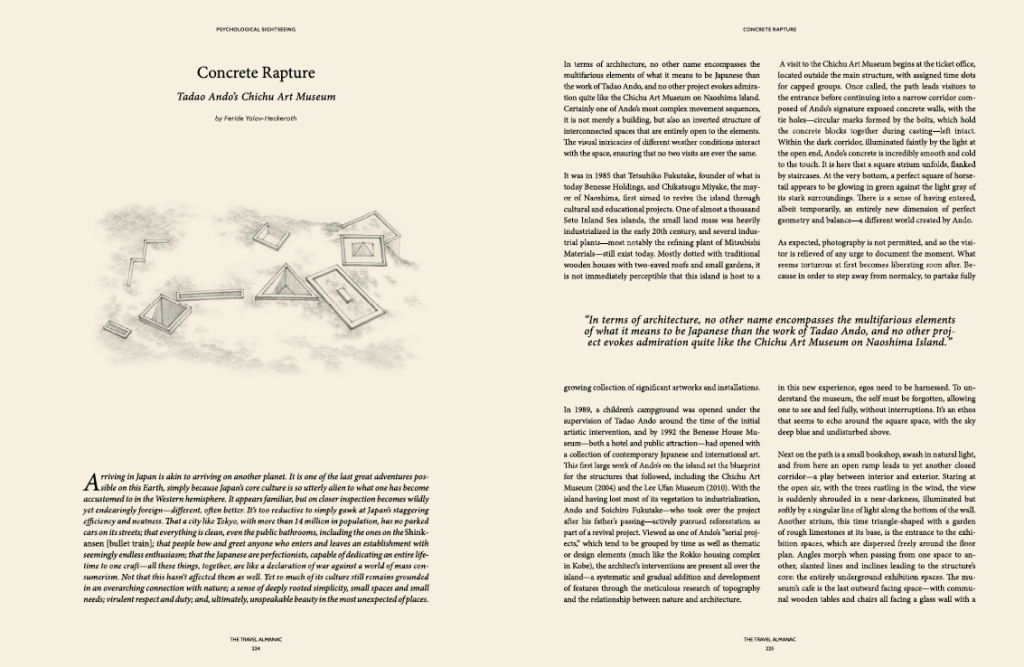
In terms of architecture, no other name encompasses the multifarious elements of what it means to be Japanese than the work of Tadao Ando, and no other project evokes as much admiration quite like the Chichu Art Museum on Naoshima Island. Certainly one of Ando’s most complex movement sequences, it is not merely a building, but an inverted structure of interconnected spaces that are entirely open to the elements. The visual intricacies of different weather conditions interact with the space, ensuring that no two visits are the same.
It was in 1985 that Tetsuhiko Fukutake, founder of what is today Benesse Holdings, and Chikatsugu Miyake, the mayor of Naoshima, aimed to revive the island through cultural and educational projects. One of almost a thousand Seto Inland Sea islands, the small land mass was heavily industrialized in the early 20th century, and several industrial plants—most notably the refining plant of Mitsubishi Materials—still exist today. Mostly inhabited by traditional wooden houses with two-eaved roofs and small gardens, it is not immediately perceptible that this island has been hosting a growing collection of significant artworks and installations.
In 1989 a children’s campground was opened under the supervision of Tadao Ando alongside initial artistic intervention in the public space and by 1992 the Benesse House Museum opened, a hotel and museum with a collection of contemporary Japanese and international art. This was Ando’s first large work on the island, which also dictated the structures to follow including the Chichu Art Museum (2004) and the Lee Ufan Museum (2010). Having lost most of its vegetation due to industrialization, the revival project also included a reforestation campaign, actively pursued by Ando and Soichiro Fukutake, who took over the project after his father’s passing. Viewed as one of Ando’s serial projects (much like the Rokko housing complex in Kobe), the architect’s interventions are present all over the island—a systematic and gradual development of projects through the meticulous research of topography and the relationship between nature and architecture.
A visit to the Chichu Art Museum begins at the ticket office, located outside the main structure, with assigned time slots for capped groups. Once called, the visitors’ path leads to the entrance and continues into a narrow corridor composed of Ando’s signature exposed concrete walls, with the tie holes—circular marks formed by the bolts, which hold the concrete blocks together during casting—left intact. Ando’s concrete is incredibly smooth, cold to the touch within the dark corridor illuminated faintly by the light at the open end. It is here that a square atrium unfolds, flanked by staircases. At the very bottom, a perfect square of horsetail appears to be glowing in green against the light gray of its stark surroundings. The feeling is of having entered, albeit temporarily, an entirely new dimension of perfect geometry and balance, a different world created by Ando.
As expected, photography is not permitted and so the visitor is relieved of any urge to document this moment. What seems torturous at first becomes liberating soon after. Because to step away from normalcy, to partake fully in this new experience, egos need to be harnessed. To understand the museum, we first need to forget ourselves, so that we can see and feel fully, without interruptions, is the ethos that seems to echo in this square space, with the open sky deep blue and undisturbed above.
The path continues on to a small bookshop followed by an open ramp and another closed corridor, a play between interior and exterior: staring at the open sky with the trees rustling in the wind, followed by darkness illuminated softly by a perfect line of light running along the bottom of one side of the wall. Another atrium, this time triangle-shaped with a garden of rough limestones at its base, is the entrance to the exhibition spaces, which are freely located around the floor plan. Angles morph when passing from one space to another, slanted lines and inclines leading to the structure’s core: entirely underground exhibition spaces. The museum’s café is the last outward facing space—with communal wooden tables and chairs all facing a glass wall open to a view of the horizon, the sea, the dark shadows of other islands under the fleeting strokes of clouds.
Past an open glass door and into the concrete core, the James Turrell section begins with the early artwork, Afrum, Pale Blue, composed of light projected into a corner, which the human eye perceives as a convex or concave cube. Behind this room, more white walls lead to another artwork by Turrell, Open Field, a spatial-light installation. Here, stairs lead into a rectangular opening, where monochromatic lights illuminate a space. When one turns away from the entrance and faces the installation fully, the slowly changing pastel colors dissolve all sense of space and direction, human form melting into pure color.
The third Turrell work, Open Sky, is a room with an open roof—a cut-out square allowing for the natural light to cast its endless visual apparitions on the white walls below. Ando worked directly with artists to design architecture that is specific to the artworks it houses, and this room acts as a perfect example of this confluence of art and architecture. The complete blurring of the line separating the two, leads one to wonder whether they are not,ultimately, the same thing.
The following area is overseen by museum staff, allowing only a certain number of people to enter simultaneously. Street shoes are prohibited, and beneath a long bench of heavy wood lies a row of white slippers—the kind that luxury hotels might offer their guests. The slippers help protect the floor of the Claude Monet room, which is bedecked in small handmade white marble blocks. It is a pristine antechamber, where the colors of Monet’s giant diptych painting Water-Lily Pond are suddenly and unforgettably verdant and deep. There is no better way to admire a single work of art—silent, in slippered feet, without the distraction of phones, crowds and the usual selfish thoughts or desires.
According to Ando, “the cultural role of architecture is the affirmation of individual experiences of physical and spiritual existence in the world,” and in the Monet room, where a further four more paintings from the Water Lilies series hang, this affirmation is most apparent. The viewer becomes one with the space and the art, the novelty and adventure of being, for once, entirely present causing them to reassess their very existence.
After returning to the main triangular atrium via descending stairs, the last exhibition awaits on the lowest floor. Walter De Maria’s Time/Timeless/No Time is composed of a giant, polished, black granite sphere that stands on a central platform between two sets of ascending wide staircases. The space is subject to the play of daylight, which enters from the open sides of a kind of floating double ceiling and its central rectangular skylight. On the walls and floor are gilded wooden bars on concrete consoles. Developed through a close collaboration between architect and artist, the scale and impact of this echoing space is truly monumental, almost sacral.
After an ascending corridor with an ongoing diagonal slit facing the inner courtyard, the journey through Chichu ends with an entirely different perspective of the same space. From start to finish, through perspective, form, expression and the juxtaposition and harmony of opposing forces, the curated trail constitutes an awe-inspiring experience. Brutalist architecture, nature and art, seamlessly connected.
On the ferry back to Uno Port, as Naoshima begins to diminish in size, the impression of Ando’s work prevails, vivid and profound. In the evening, whether slurping Tonkotsu ramen or tucking into a side of fried gyoza, there is a sense of understanding Japan a little better, a newfound feeling for its simplicity and man’s intrinsic role in nature, as in the Shinto worship of Kami, the spirits of nature that dictate life. Perhaps these are the same forces that move the light on concrete surfaces, the rain that spatters and changes its color, the wind and the humidity, the cold and the heat. For life is a cycle—within and of nature, blooming and rotting ad infinitum—that we are part of, in flesh and in spirit, in concrete, steel and glass.
The Travel Almanac, TTA25, Adventure

 Feride Yalav-Heckeroth