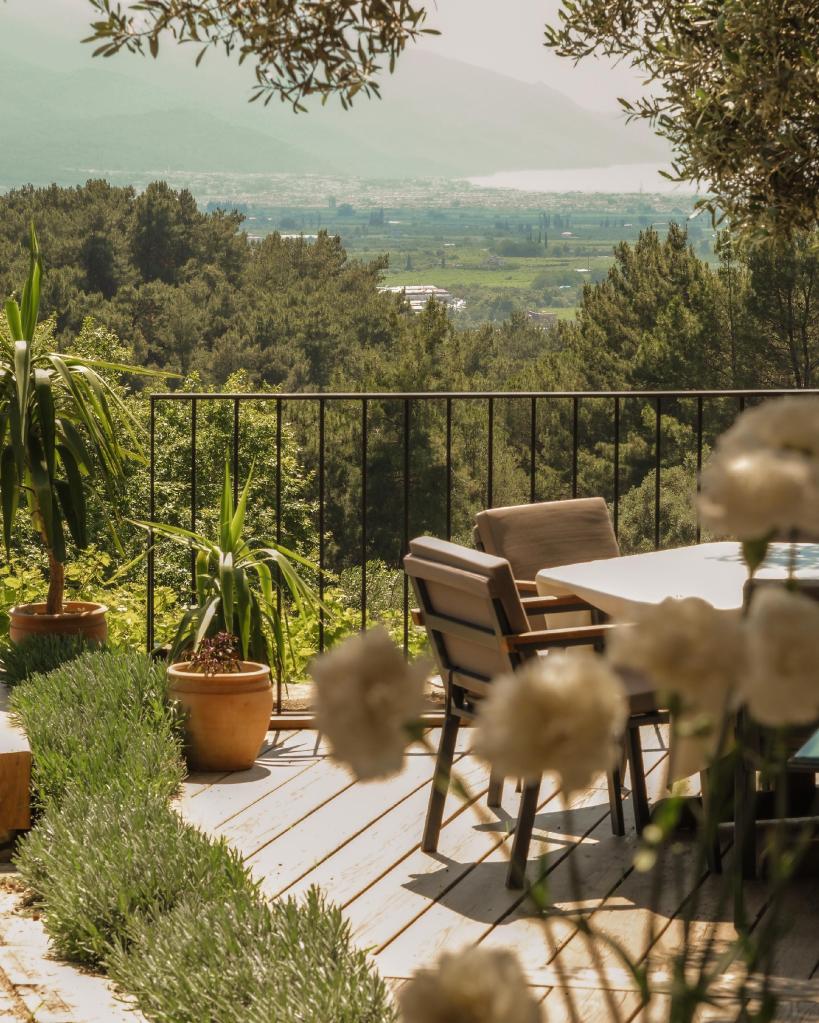
After getting off the D515 state highway to Kuşadası, a meandering asphalted road cuts through the Aegean landscape with its soft hills and valleys covered in olive groves and pines, leading to the village of Caferli. Not a lot of people would think to come this way, but it’s exactly here that you’ll find one of Turkey’s most groundbreaking destination restaurants, steeped in the philosophy of “benefiting from nature, whilst sustaining nature.”
Chef Damla Uğurtaş’s Çiy Restaurant overlooks the evergreen valley and the Aegean Sea from its outdoor terrace where tables rest in the shade of a large olive tree. “Since the inception of Çiy, I dreamt that it would be located in a village, which reflected the character of the Aegean, in a place where we could feel the spirit of the trees and even the sea,” says the chef, an Izmir native who veered from her degree in English literature to pursue a culinary career including a degree from MSA (Istanbul’s esteemed culinary arts academy).
Previously the chef of the 7 Bilgeler vineyard’s kitchen in the nearby village of Gökçealan, the realization of her own restaurant was an arduous undertaking of meticulous renovation and construction. “Even though it was tiring in terms of time and costs, moving forward without damaging the structure of the land and the regional flora was very much worth it and resulted in details which we perceive with pride,” says Uğurtaş.
Upon entering the main gate, the restaurant and guesthouse appear like a village-within-a-village with its structures of natural stone masonry and descending pathways leading past herb gardens and terraces overlooking the expansive valley. While the main structure–which includes the restaurant on the ground floor and three rooms upstairs–was newly built, the other three guesthouses are inside renovated village homes. And it’s the details that set the mood. From the specially chosen vintage furnishings in every room to the small doilies that rest on the water glasses to the traditional carpets, a down-to-earth solemnity reigns.
The restaurant itself is an anomaly for this unknown village, a fine dining endeavor with a tasting menu that is both shaped by the imagination of its chef as well as the ingredients of the region. “Çiy is a reflection of my love for nature,” says Uğurtaş, “I prefer a cauliflower that happily resisted the cold in winter over a bland pepper that is harvested by forcing the soil. I tell the producers I work with, ‘I will only buy what grows beautifully, non-toxically and with a high yield in your soil.’ Instead of expecting my farmers to produce ingredients they’re unfamiliar with, I ask for the best and most low-intervention product that they know and already produce. As such, I believe I leave room for them to do their job, whilst I do mine. The region is already multi-layered and fertile. Playing with existing products makes me happy.”
Translated to the plate, the chef’s dishes embrace simplicity, allowing nature’s flavors to present themselves fully, but are also enhanced through technique and experimentation, which lift them from flavorfully satiating to very memorable. “I never imagined Çiy as a restaurant in a city, that’s why I always feel that we’re exactly in the right place,” says the chef and mother. “Ease of access to our ingredients and producers is our biggest advantage, and since our priority is taste, this is the restaurant’s most defining feature.”
Uğurtaş’s savory éclair has powdered shrimp shell within the pastry, is filled with a shrimp cream and is accompanied by a cup of peach kombucha, for example. Her homemade pastas, which she learned training alongside a renowned Italian chef in Istanbul, are topped with veal ragout, or composed of ancient grains such as Kızılca wheat and served with thinly sliced calamari in a sauce of egg yolk, Bergama Tulum cheese, olive oil and fermented mussel juice. Plates are paired with wines from a list that focuses more on Turkey’s boutique vineyards.
The more casual lunch service at Çiy differs according to the day. On Sundays there are brunches with towering croquembouche filled with cream and serenaded with caramel threads, for example. On Saturdays the Çiy burger takes center stage with its homemade pickles, ketchup, peach mustard, and buttery bun. And on Wednesdays, Uğurtaş and her team, who already love to make their own sourdough bread, make a signature sourdough pizza.
Preferring to define her food as “healing Mediterranean cuisine,” Uğurtaş is part of a newly burgeoning gastronomical movement in Turkey, which focuses on not only satiating the palate, but also the soul. Chefs that are leaving the cities to open their restaurants in remote locations, closer to nature and its serenity, to their ingredients, to the rich culture of different regions. “Damla Uğurtaş is breaking new ground with her fusion cuisine in a very unknown location,” says Adnan Kaya, a columnist for Hürriyet newspaper focusing on Aegean culture. “This trend seems to be the new philosophy in Turkish gastronomy and Çiğ will be among the pioneers.”
“We are aware as humans that the planet can no longer meet our demands and this is where Chef Uğurtaş arrives with her healing cuisine,” says Kaya. “She creates her own dishes without rushing, with true ingredients from the region, with respect to the seasons, and every member in her staff is integral to this, they all present their unique contribution. They all grown and learn together, becoming more beautiful with each day as they complete each other, produce together, cook and laugh. And this is reflected in the flavors. Let’s hope all restaurants can be like this.”
Far away from the chaos of a Turkish mega city like Istanbul, Çiğ sits quietly in its village, visited only by those who have heard of it, the soft hum of conversation on the terrace, the valley vast but silent, a cold signature cocktail at the bar, the smell of the restaurant’s own mosquito repellant made from local herbs on the skin. All of this and more making it easy to believe in this small but significant revolution in Turkey’s food scene. Closer to nature and in harmony with nature.
“Hosting guests requires a detailed execution from top to bottom and in a remote village you can’t achieve this with food alone,” says Uğurtaş. “That’s why a holistic way of living prevails at Çiy. We welcome our guests with a philosophy formed by the contribution of the village, the region, the people we work with and our own personal values. Every detail exudes this philosophy, from the fabric to the colors, the plates to the food, the staff to the music played, the glasses to the wine list. This is what I love most about my own restaurant.”
 Feride Yalav-Heckeroth