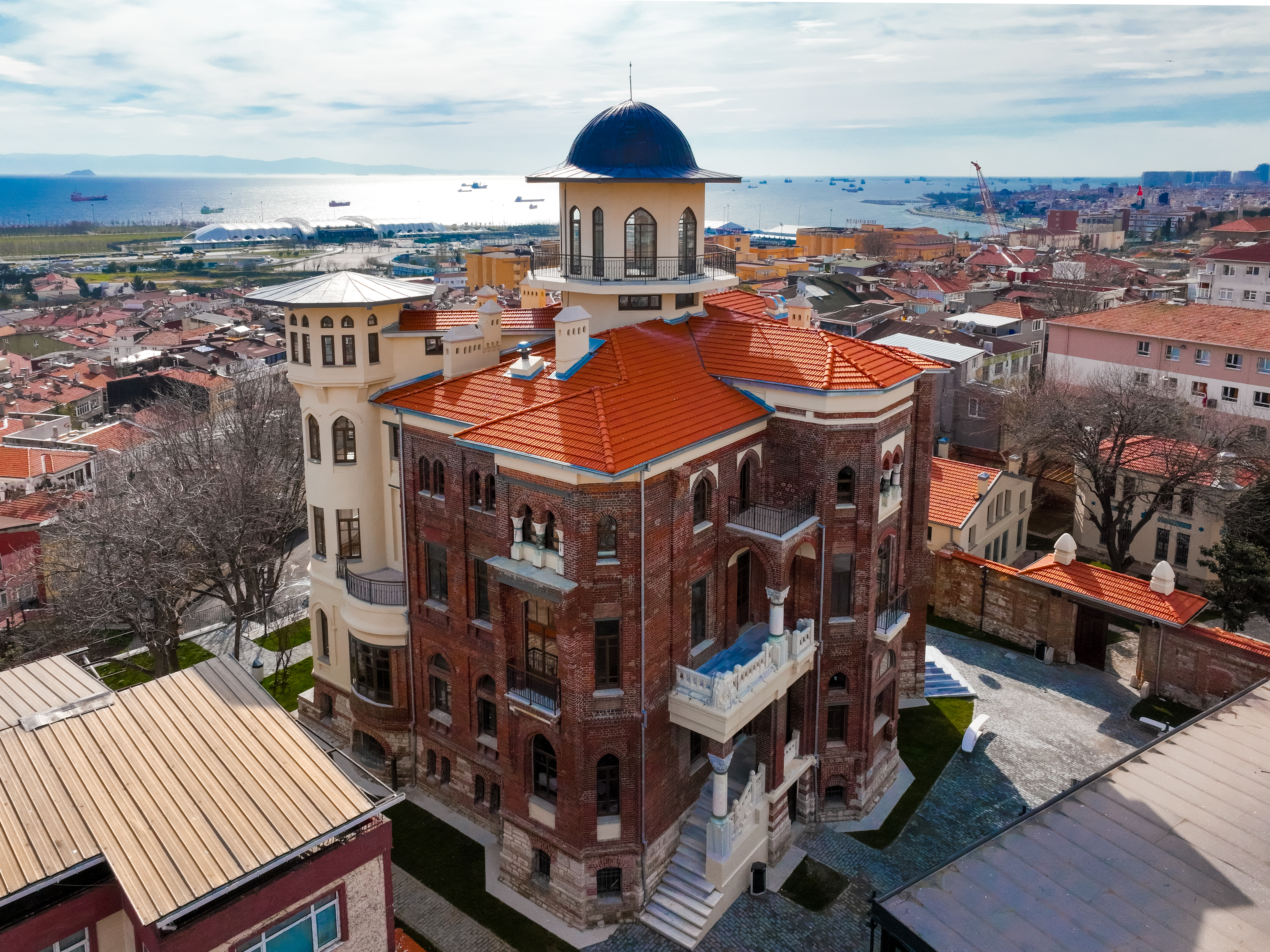
What happens to a city when a large number of formerly forlorn structures are suddenly revived, restored, and opened to the public as centers of culture and art? Free of charge? You can argue about the perils of Istanbul, a city that is suffering from the effects of its overpopulation, its awry politics, its weakness to the destructive forces of looming natural disasters. But the small silver lining to all of this (and apart from Istanbul’s seemingly indefatigable resilience to all its shortcomings) is the Miras (Heritage) project run by the Istanbul municipality, simply known as İBB Miras.
Dilapidated old structures have always fascinated me and unlike the city’s newly emerging skyline—which is being exponentially defined by cheaply made apartment buildings clad in plastic facades—they possess substance, charm and sentimentality in the form of memories. No newly made, copy-paste and haphazardly designed apartment block can compare to the subtle yet robust beauty of the Neoclassical to Modernist structures of the past. Not to me, anyway.
It’s cliche to say something like, “if these walls could talk,” but the sentiment I’m trying to express is surely there. I’m wont to forget a lot of things, but poignant visuals always stick permanently to my mind. Beautiful old abandoned structures fill me with a special form of melancholy…the mural of those gliding angels on the ceiling of an old and peeling palazzo in Palermo, the excruciatingly beautiful white marble columned entrance to a Bosphorus mansion on Balta Limanı Caddesi (number 35, I believe). It must be the lingering fantasy of those grand spaces, which were once filled with life, now decomposing silently, returning to the earth, much like the people who once inhabited them.
But I digress.
In terms of İBB Miras, the opposite of this melancholy is at play, because life is surely returning to historic structures all over Istanbul, and, most importantly, through a restoration practice that is low intervention, respecting the integrity of the historic architecture. Conserving and repurposing rather than demolishing and making something new and cheap is precious for Istanbul, since it’s becoming so rare. And to take this argument a bit further, the interior design is another admirable element, often carried out by local design studios, which imbue the renewed structures with a contemporary aesthetic that is not dusty in the least but fits in seamlessly with the city’s privately owned venues that tout Western-style modernity. In terms of figures, İBB Miras has taken 943 structures under protection, opened 22 new public spaces for art and culture, and restored 63 monuments, 34 public art works, 197 Ottoman era fountains and 588 historic cemeteries.
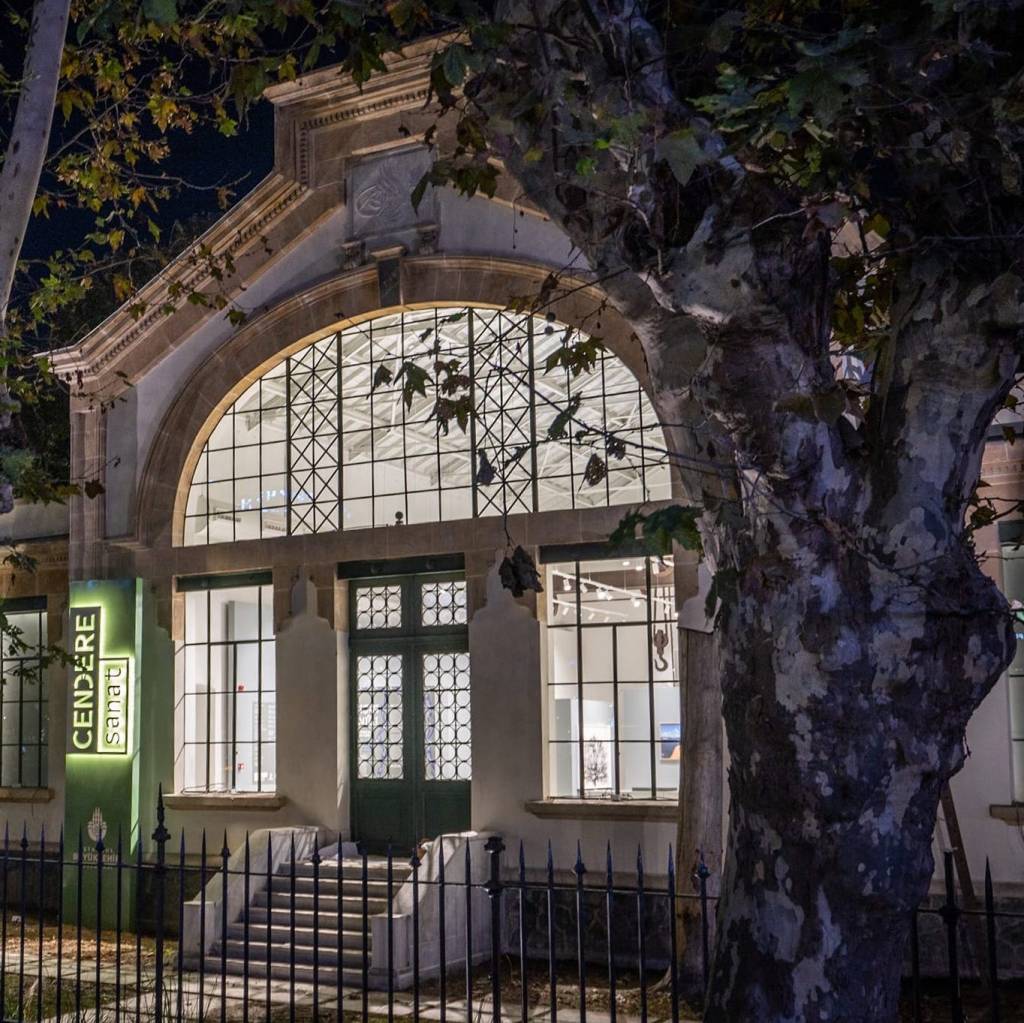
Some examples include Cendere Sanat, an art gallery inside a former pumping station from 1902 that provided water to around 100 fountains all over the Ottoman city. Its glass pavilion-cum-café was created by the local design firm Zemberek Design. There’s Müze Gazhane, a more ambitious endeavor (even featured by Domus in 2021), an Ottoman-era gasworks, now a gigantic playground for art and culture with exhibition halls, performance stages, museums and cafes. The sprawling Feshane, an Ottoman military textile manufacturing plant, is another one of these ambitious projects, now serving as one of the city’s largest spaces for national and international art and culture exhibits. More recently, the former Dökmeciler Çarşısı (bazaar of metal casting workshops from the Ottoman period) inside the Süleymaniye Mosque complex was inaugurated as the Istanbul Design Museum with its new designer and artist ateliers. Baruthane, another Ottoman factory (albeit for gunpowder), was restored, with its cavernous and arched stone halls reimagined as the perfect spaces for a library and stage. The central pavilion, an addition to the historic ensemble, composed of a steel structure surrounded by a sun shading shell of timber battens, was designed by the local studio Per Se.
Of course, there are a few projects that are a bit closer to my heart. The Moda İskelesi, which graces the cover of the second edition of my guidebook, is, of course, one of them. Built in the early 1900s by Vedat Tek (one of the leading figures of the First Turkish National Architectural Movement), it was left to its vices for years before Miras and the young architecture firm Novos Studio came along and gave it a much-needed facelift. So to speak. The Moda neighborhood’s iconic pier, with its stained-glass windows and arches in turquoise hues, now has a café on the ground floor and a library and reading room on the first. Its wraparound terrace will also forever remain in my memory, as I stood and stared at the sea there, thinking about nothing, at one with that tiny line that lies between salty water and vast horizon. That’s what good architecture is capable of, after all, allowing us to appreciate our existence by changing our perception entirely, astounding us and forever altering how we understand space (shelter) and the natural world in which it must exist and somehow find harmony. As must we.
But I digress again.
Another project from Novos Studio in the Miras portfolio is Taş Mektep on Büyükada, a once-abandoned stone summer mansion built in the 1870s by French architect Alexandre Vallaury for Sophronios, the Patriarch of Alexandria. This one even made the rounds on Arch Daily. And it surely deserves it, with its minimal spaces in exposed brick and wood overlooking a central courtyard (and the sea). Another project close to my heart is the recent restoration of Bulgur Palas (number 256 in my guidebook) a remarkable mansion designed by the Levantine-Italian architect Giulio Mongeri in 1912 for Mehmet Habib Bey, who made a fortune selling bulgur (cracked wheat)–hence the name. Another prime example of Turkey’s First National Architectural Movement, the confluence of Ottoman and neoclassical elements is striking, especially in its restored form, exuberant once more after being abandoned for so many years.
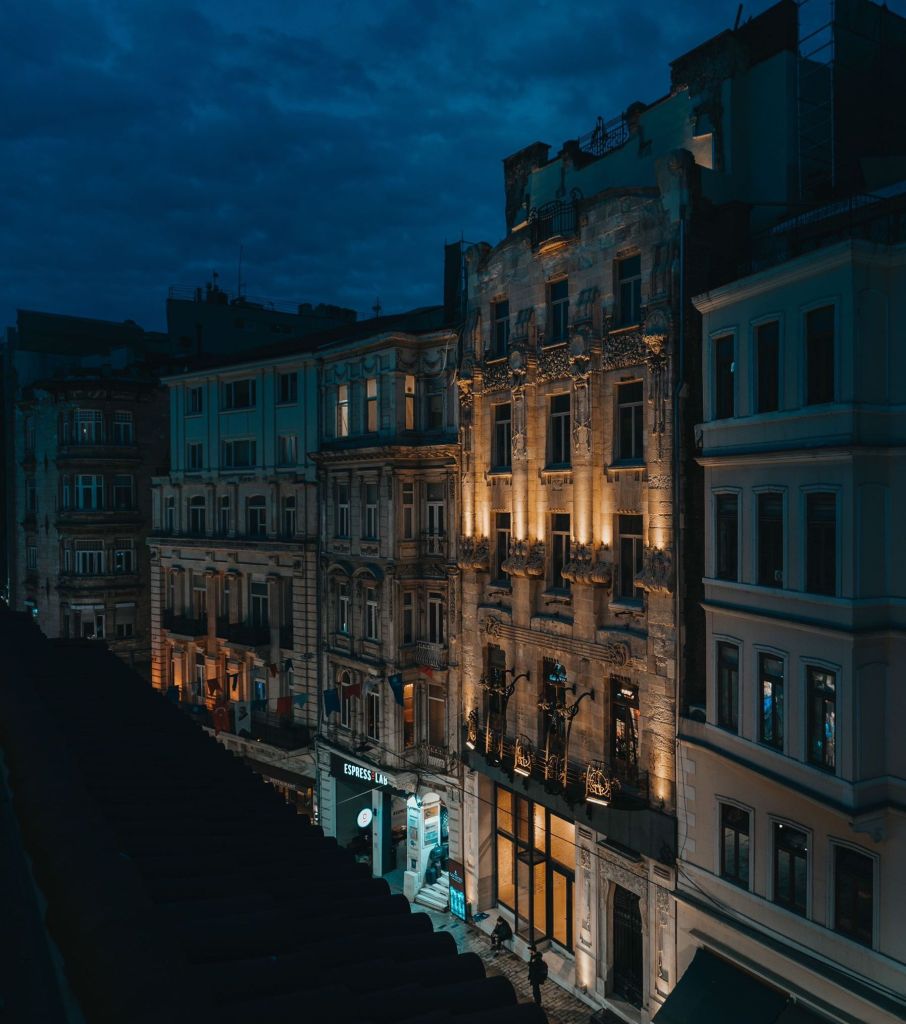
The last structure I want to mention in more detail is Casa Botter. Or that beautiful Art Deco apartment on İstiklal Caddesi, which was ignored for years. I think my admiration for the Miras endeavor began with this restoration in particular, just because I had walked by this building so many times and lamented its downfall. So, good things do happen, even in Istanbul. This particular apartment was designed by Raimondo D’Aronco (the Italian innovator who served as Abdülhamid II’s chief architect) in the 1900s and was the rather opulent residence and workshop of Jean Botter, the sultan’s own couturier. In its current form, there is an art gallery on the ground floor, but what some people miss is the main entrance on the right, surrounded by a grand marble floral relief, which leads up the stairs—past one of those iconic birdcage elevators from an Istanbul of a more sophisticated era—and up into a reading room with design furniture. The original parquet floors are stunning and still creak when you walk on them, as they should. The fact that a lot of people come here just to shoot Instagram photos from the newly added steel balcony is up for discussion, but at least they’re coming. And the floors are creaking again with life, maybe even joy, if inanimate things can indeed harbor emotions (why not).
Thank you for reading.
 Feride Yalav-Heckeroth