Often overshadowed by the cosmopolitan effulgence of Istanbul, the cultural and architectural treasures of Ankara have remained mostly undiscovered by mass tourism.
From the 50. Yıl Park in the Çankaya neighborhood the city presents its sprawling self, a mixture of old and new, the orange roofs of apartment blocks, the peaks of high-rises, the welcomed green interruptions of city parks, the subtle rise of the hills beyond.
When Ankara was declared the new capital after the proclamation of the Turkish Republic in 1923, it was difficult to imagine how a countryside province in the midst of Anatolia would become a sprawling city. But it did. With a new city plan, designed by German architect and urban planner Hermann Jansen in 1932, Ankara was given a boulevard, Atatürk Bulvarı, and soon European and American-influenced structures began to sprout along it, as well as brand new cafes and restaurants in the same modern demeanor.
Convinced that the arts were the ultimate representation of modernity, the new capital city needed an opera and in 1948 the Ankara State Opera and Ballet was inaugurated. Renovated by the German architect Paul Bonatz, the large curving structure with its elegant columned interior continues to host opera, ballets and concerts.
Vital government structures like the astoundingly imposing Turkish Grand National Assembly, Ministry of Defense and Çankaya Mansion (the official residence of the vice president), among others, were designed by the Austrian architect Clemens Holzmeister. And between 1961 and 1980, the city obtained one of its most important university campuses, the Middle East Technical University, one of Turkey’s most important works of Brutalist architecture designed by Behruz and Altuğ Çinici.
Nowadays, the remnants of this nation-building project can still be felt in the architecture of Ankara, its masterplan, its museums, universities and centers of the arts. But Ankara has continued to grow, calcifying its own identity far away from the glamour of Istanbul. Ankara is quieter, greener, more organized, more livable, a confluence of its history and the youthful energy of its large student population that attend its many universities. Ankara is a city with its own colorful identity, on the down-low, and therefore still erroneously stereotyped as gray and bureaucratic.
Classic Ankara
As the new capital of the newly established Turkish Republic, one of Ankara’s most important and well-known sites is certainly Anıtkabir, the imposing marble and travertine mausoleum of Mustafa Kemal Atatürk, the republic’s founding father and first president.
Yet, perched on a hill overlooking the Kale neighborhood’s colorful Ottoman-era houses, the Ankara Castle (a fortification from around the 7th century) marks the city’s most visited quarter. It is here that the Museum of Anatolian Civilizations harbors one of the most significant collections of artifacts that traverse Anatolia’s most important archeological sites. Next door, the newly established Erimtan Archeology and Arts Museum, inside three beautifully renovated historic Ankara houses, also exhibits 2,000 works from the Roman, Urartu, Hittite, and Byzantine ages.
Just a few steps away, Divan Çukurhan–one of the city’s most elegant hotels inside a lovingly restored 16th-century caravanserai–is the place for visitors to take a Turkish coffee and dessert break whilst lounging on leather sofas in the building’s main arcade. Outside, the many descending cobblestoned streets of Ankara’s historic Samanpazarı quarter are filled with ateliers and shops selling crafts and antiques with an abundance of handmade goods on display outside every vendor, as well as hidden historic caravanserais with artisan shops such as the Tarihi Pilavoğlu Han Çarşısı.
A hidden gem among the antique and artisan shops here is the Aslanhane Cami, one of Ankara’s oldest mosques, which was recently included in the UNESCO List of Wooden Hypostyle Mosques of Medieval Anatolia. As expected, the mosque’s most important element is the ornate woodcarving found on the ceiling, mihbar and minbar, a truly minute weave of floral and geometric patterns.
Ankara’s Museums
The Ankara Ethnography Museum, the new republic’s first museum built between 1925-1928 by Arif Hikmet Koyunoğlu, exudes an architectural style heavily influenced by the regal Ottoman aesthetic. An ode to Turkish handcraftsmanship from the Seljuk era until the present, the exhibition inside includes colorful folk costumes from all over Anatolia, and intricate Ottoman calligraphic and Turkish tile and glass art.
Right next door, the Ankara Painting and Sculpture Museum is another thing of exceptional beauty built between 1927-1930 also by Koyunoğlu in the same regal style of towering and ornamental marble details. Inside the halls and rooms with their antique chandeliers and ornate ceilings, more than 150 years of Turkish art is on display.
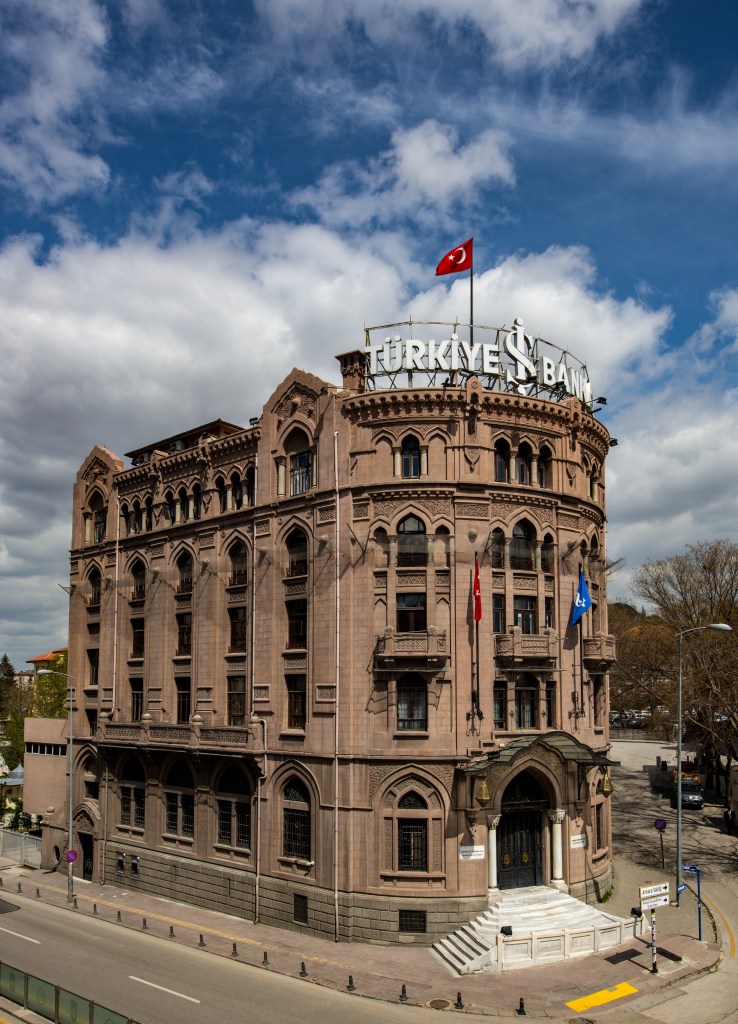
About a twenty-minute walk away and past the iconic Gençlik Parkı–the exemplary city park of the new capital inaugurated in 1943–the façade of the İş Bankası İktisadi Bağımsızlık Müzesi (İşbank Economic Independence Museum) is impossible to overlook. The four-storied building with its lancet arches and floral ornaments was designed by the Italian architect Guilio Mongeri in 1929 including an oval stained-glass ceiling in the main hall, which depicts Hermes, a mythological deity associated with money.
The city’s main hub for contemporary art is undoubtedly Cer Modern, founded in 2010 inside a former railway workshop, the word “cer,” befittingly refers to the traction of an engine which powers a train. Hosting exhibitions both inside the vast halls and outside in its art garden, the gallery also organizes workshops and film screenings and has its own café.
Ankara is not Gray
“People usually go to Ankara for bureaucratic affairs whether it’s an exam, visa application or a job related to the judiciary…and so they end up seeing the city from this gray perspective,” says Ragip Soylu the Middle East Eye’s Turkey Bureau Chief who moved from Washington to Ankara in 2019. In 2020, Soylu began the Instagram account Ankara Gri Değil (Ankara is not Gray), a collection of his personal photographs that show off the capital’s colorful side. “For me what makes Ankara special is that it’s an orderly and more peaceful place with less traffic, less crowds, lower inflation than other big cities…While it has become impossible to live in Istanbul, it is quite possible in Ankara. In every sense,” he says.
“There are many places I like in Ankara. Watching the exhibitions and talks at Ka Atölye; discovering the architectural and cultural heritage in different parts of the city with Urban Walks Ankara; listening to a classical music concert at CSO Ada; having breakfast at Kakule Fırın and Sarnii; eating pizza at Mozz Pizza; and enjoying döner kebab from a female chef at Kebapçı Canbolat.”
Soylu, who often compares Ankara to Washington, also recommend discovering the historic Ankara houses of the Hamamönü neighborhood, the new third-wave coffee shops in the Bahçelievler neighborhood, and enjoying the view from Atakule, the iconic tower belonging to the city’s first modern mall originally built in 1989.
A Weekend in Eskişehir
Thanks to the high-speed Turkish Railways train system, the ride to the nearby university town of Eskişehir has become one of the most popular weekend getaways for Ankara residents. Touted as one of Turkey’s most European towns, Eskişehir is also famous for the Odunpazarı Historical Urban Site, an open-air museum, which showcases some of the best-preserved examples of traditional Turkish architecture. The site is also home to the Atlıhan Crafts Bazaar, where the production, display and sale of traditional handicrafts are preserved as well as the world’s only Meerschaum (sepiolite) museum-known as lületaşı in Turkish.
Since 2019, Eskişehir has also become a prime destination to visit the OMM (Odunpazarı Modern Museum) designed by the internationally acclaimed Japanese architecture firm Kengo Kuma and Associates. Housing the modern art collection of architect and contractor Erol Tabanca, the impressive structure composed of stacked and interlocking timber beams is one of the country’s most imposing modern museums.
Right next door, the OMM Inn is a modern boutique hotel inside a renovated Ottoman-era Odunpazarı house with its own café and restaurant–featuring an innovative menu free of any animal products–as well as a shop selling eco-friendly and sustainable goods.
 Feride Yalav-Heckeroth