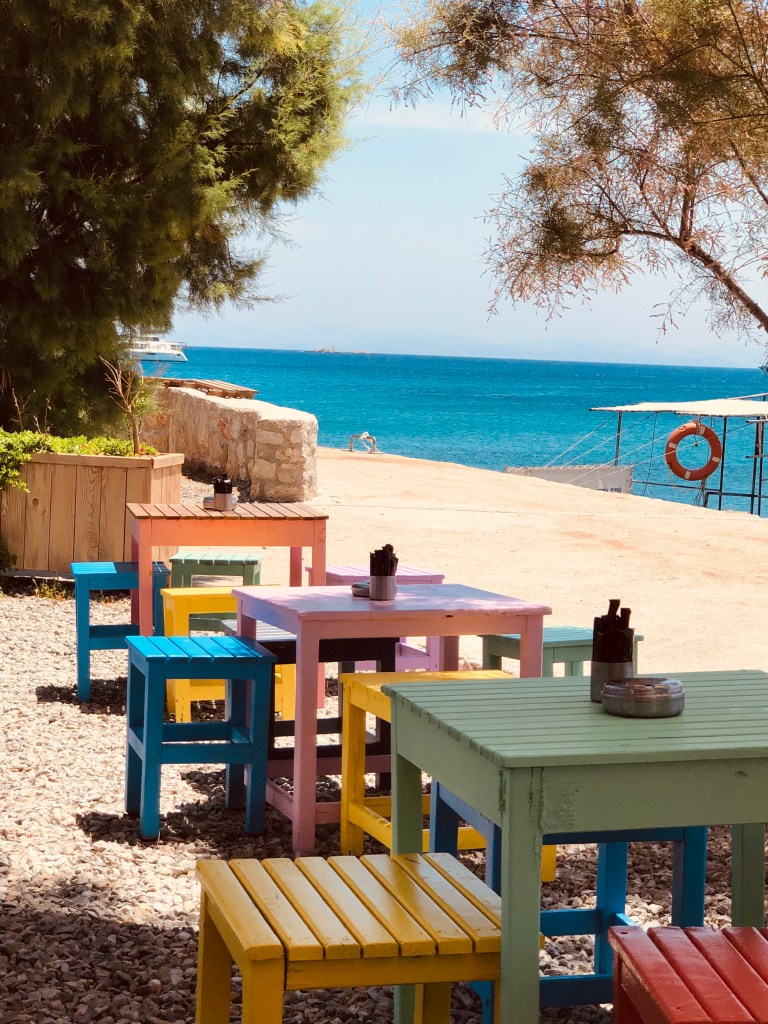
A narrow and long peninsula that stretches between the Aegean and Mediterranean Seas in the south-west of Turkey, Datça’s most important trait is its untouched nature. Mostly mountainous, rugged and forested with pristine bays on both sides, the peninsula harbors an island feel, cut-off from the touristic boom of nearby towns like Marmaris and Bodrum.
With around 95% of the peninsula composed of uninhabited wild terrains and strict laws about construction, Datça has been able to protect itself from large-scale touristic projects. Datça’s eponymous small port town, located around midway on the peninsula, is the epicenter of local life. Fish restaurants with simple wooden tables and chairs line the waterfront, whilst little shops selling local goods and modern cafes fill the backstreets that move up and down the hilly residential landscape. Flashes of Aegean blue can be observed from between the white houses with their classic orange roofs on the slopes, which look down on the harbor, where mass tourism hasn’t disturbed the carefree rhythm of daily routine.
Other points of local life hide in the nine small villages of Datça, scattered all around the peninsula, and visitors often have to drive through their narrow streets to get to the other main point of attraction: the ruins of Knidos, once a Greek city in ancient Caria. Located on the very western tip, the road that leads to the historic site also snakes its way past fragrant pine forests, towering mountains and the many orchards where Datça’s famous almonds are harvested.
In the summer, domestic tourists crowd the major bays, such as the very popular Palamutbükü with its long pebbly beach, aquamarine sea and rows of small family-owned restaurants. Yet locals often stay away, preferring to spend their days at one of the many untouched coves, some of which only they know about.
A ten-minute drive south from downtown, the narrow streets of Datça’s old town are almost always crowded, with its historic stone houses and many touristic cafes and shops and the much-revered former summer home of famous Turkish poet, Can Yücel, attracting visitors.
Where to Stay
After a stroll down Datça town’s waterfront boardwalk, lovingly named the Sevgi Yolu (Love Path), one of the peninsula’s newest accommodations comes into view, bordered by the ancient ruins of a bathhouse, which was discovered during construction. A collection of two-storied houses with local stonemasonry facades, airy minimal rooms and a restaurant serving contemporary Aegean dishes, Palaia Hotel is a modern and sustainable interpretation of traditional Datça architecture and culture.
“I’ve been in love with this peninsula since 2000 and when I stumbled on this property, I knew I wanted to create a peaceful place, harmonious with its surroundings,” says Ismet Tekinalp, the owner of Palaia. “One of the most precious things in Datça is the quality of its air, I wake up every day just breathing in this pure oxygen. I think people who come here need to see the ancient ruins of Knidos, explore beautiful coves such as Hayıtbükü, taste the fantastic local Datça almonds and pine honey, and take part in the annual Almond Blossom Festival in February.”
In the midst of Datça’s old town the traditional stone houses and their garden, which were formerly the vacation residence of the British actor, dancer and politician Michael Cashman and his late partner actor Paul Cottingham, now serve as a modern boutique hotel. The Ultava Houses have four rooms with high ceilings, small stylish touches and terraces overlooking the lush garden.
A bit further away from Datça town in the small village of Cumalı, Gocakapı’s traditional stone houses are humble and comfortable giving a feeling of being at home in the middle of Datça’s mountainous scenery with its olive groves and almond trees swaying in the wind.
Local Flavors
In downtown Datça, shops such as Pehlivan and Datça Köy Ürünleri sell the local almonds in every form imaginable. Shelves upon shelves are stocked with packaged almonds, which are sold raw, roasted, blanched, in their shell or as almond butter, flour, marzipan, halva and oil.
At Meşhur Datça Badem Kurabeyicisi the smell of freshly baked almond cookies fills the street, and the glass display has everything from plain to cookies filled with chocolate, green apple and walnut or topped with raspberries or blackcurrants.
Bal badem, almond brittle with honey, is also quite popular and sold at Kaya Balları, which specializes in local honey, especially from pine and almond blossom. Bal badem is also a rather heavenly ingredient in local thick ice cream made from goat’s milk, best tasted at Tekin Usta, a small shop in Datça’s old town.
Located in one of the world’s oldest wine-producing regions, Datça also has a small wine scene that is worth exploring. Founded in 2011 by the Isleyici family, the Datça Vineyard and Winery offers wine tastings as well as a menu of Italian dishes that pair perfectly with their vintages such as cheese tortellini with sage sauce or pizza with braised lamb.
In the small Yaka village, about a thirty-minute drive west of town, a lot of people drive past Yakamengen without a second glance. However, inside this restored, small olive mill, a few locals have come together to create a unique restaurant where dishes are composed mainly of endemic plants and vegetables, and sometimes the bounties of the sea.
Just a few steps away and right across the UKKSA (International Knidos Culture and Art Academy) and its sculpture garden, Hestia focuses on dumplings from all around the world with a sister branch called Hestia Mey, just a few meters ahead, that also serves their dumplings as well as classic meyhane (Turkish tavern) fare such as stuffed zucchini blossoms and fried and diced liver.
An Eco Farm and a Tango School
On the western tip of the peninsula and down an undeveloped road that cuts through the peaceful backwoods, Knidia Eco Farm is one of Datça’s most well-kept secrets, a place to really delve into nature’s tranquility. Founded by Ali Somer in 2000, who left Istanbul’s urban chaos to become a farmer, the 12 acres of farm, vineyard and orchards began hosting guests in 2007, with four wooden huts and four stone houses. Meals are made almost entirely from ingredients grown in the Knidia garden and prepared on a wood fire, while the nearby beach at Değirmenbükü is completely serene without any facilities.
“I think one of the most precious things here is its peacefulness, the night sky is unadulterated, there are no artificial sounds or lights here, just the sounds of nature, the wind,” says Somer. “Datça is one of the rare places in Turkey where you can encounter an Aegean landscape that hasn’t been disturbed for centuries. The protective laws have worked well here for years, and the rugged landscape has also prevented progression in terms of construction. I hope it will continue like this, that it will continue to be protected, that people will abide by these laws, that things will remain untouched.”
“A lot of people who moved to Datça share the same story. They worked very hard and came to a point in their careers where they needed to change things, to slow down,” says Ayça Boylu who runs the tango school Tango Kairos with her German dancing partner Axel Korf. With years of national and international experience, the two dancers host classes and milongas, as well as performing at events. “Datça is a peninsula, but it’s more like an island, we’re very isolated and have our own way of life. They say, if you’re in a hurry, you shouldn’t be in Datça, because people here are relaxed. You’ll often find shops that are closed because the owner is at the beach, and that’s completely acceptable.”
Photo by me
2026 Addition:
Inside a converted olive oil mill, chef Duru Akgül has opened her restaurant Yakamengen serving contemporary dishes that are composed of prime ingredients from the region as well as her own kitchen garden. Unique dishes like blue swimmer crab with yoghurt cream are paired with local wines.
 Feride Yalav-Heckeroth