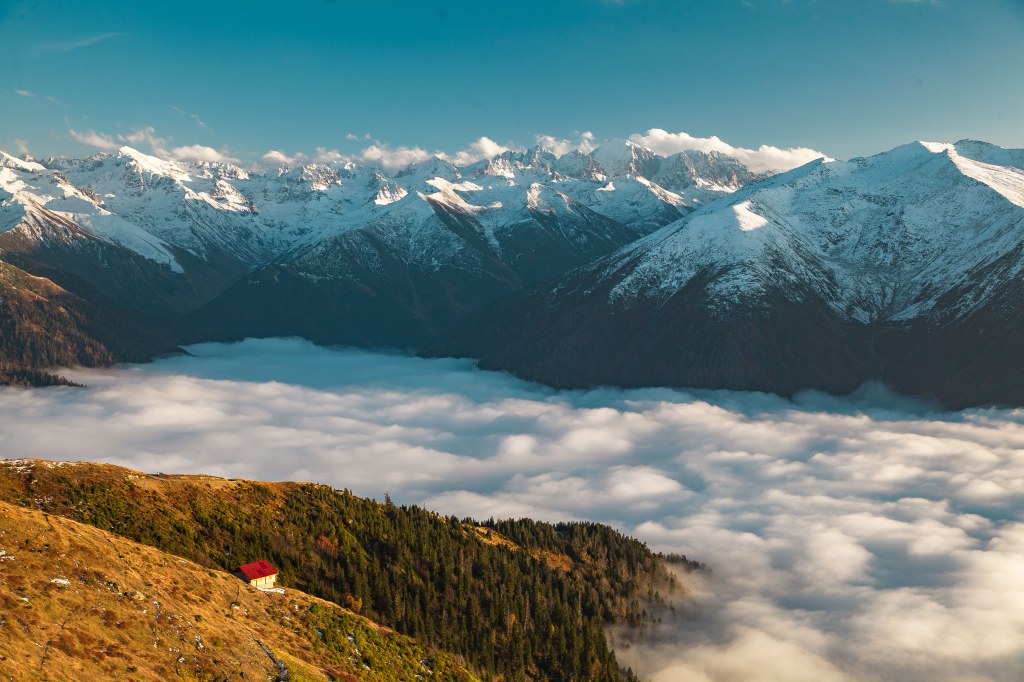
The Rize province, in northeast Turkey on the eastern Black Sea coast, is still largely unknown to many international travelers. Yet it is here, that some of the country’s most untouched alpine terrains continue to fascinate nature lovers who want to take the road less traveled.
Away from the very urban Rize city on the coast, the Rize province’s inland valleys and their plateaus, surrounded by high-altitude mountain ridges, have remained largely rural. With high rates of rainfall, the province’s mountain villages (yayla) have become a point of escape from the humid summer temperatures of the Aegean and Mediterranean regions.
The Rize province’s most attractive district continues to be Çamlıhemşin. Nature-oriented guesthouses, cafes run by young people who left the city to live a simpler life and artists who find inspiration in unspoilt tranquility, lie at the heart of this area, where nature remains mostly untouched and wild.
From the Black Sea coast, the road to Çamlıhemşin cuts through a deep mountainous valley of effervescent green, along the torrential Fırtına River that descends all the way from the Kaçkar Mountains. With the main source of income still won through forestry, beekeeping and animal herding, time seems to have stood still in this place of pastures, valleys and traditional villages that often look out over a sea of clouds.
Karadeniz Guesthouses
Many traditional Karadeniz (Black Sea) houses in Çamlıhemşin–usually consisting of a stone-filled timber frame construction–now serve as family-owned pensions where travelers can delve into local culture. With a lack of dining options in the province, the guesthouses are mostly responsible for treating their guests to homemade flavors, most notably the fully decked out Turkish breakfast including the famous local dish mıhlama, a mixture of melted cheese and cornmeal served hot and accompanied by bread.
At Puli Mini Hotel, in Çamlıhemşin’s town center, almost every window that’s opened looks directly out onto the Fırtına River, a rush of fresh air tousling the simple white curtains. Inside a traditional Karadeniz house made of weathered chestnut wood and stone with six guestrooms, Puli’s own café serves homemade and creative tastes from local ingredients such as stuffed vine leaves or tavada hamsili pilav (fried anchovy rice). A little further away from town and nestled into the verdant mountainside, Dudi Konak is quite the sight with its historic façade of stone masonry and wood that exudes the aesthetic of a Karadeniz from the past. Built in the early 20th century by the Tarakçıoğlu family, who acquired their wealth as bakers and hoteliers in Maykop, Russia, the dilapidated and abandoned mansion was renovated meticulously to house 24 modern rooms with views of the valley and beyond.
Yayla Life
Around an hour south of Çamlıhemşin’s town center and up in the mountains, Rize’s yayla (alpine villages) harbor the essence of local life and staying here is more akin to visiting a family in their mountain cabin. Roads are often undeveloped, requiring a sturdy 4×4 vehicle and lodgings are simple and come in the form of old Karadeniz houses that face the panoramic views from their high-altitude perches. Staying in the yayla for a few days to trek along the green pastures and woods, discover wildflowers and breathe in the pristine air, is the most precious part of the Rize experience. A good rule of thumb is to avoid the Ayder Yayla, which has sadly become too crowded over the years, and to travel to other, more preserved villages.
In the Pokut alpine village, the couple Zeyne and Ahmet Şişman and their family have made visitors feel like Karadeniz locals for years at their beautiful pension Plato’da Mola. Facing the Fırtına Valley in all its undulating glory, the traditional village house has six rooms where guests wake up to the smell of freshly baked bread and the sound of cow bells outside. The family’s homemade meals revolve around the milk from their own wandering and happy cows and the boons of nature all around. Fresh clotted cream, cheeses, butter, local flower honey and fruit jams, eggs from their own chickens, homemade bread, produce from their own garden.
In the Gito village, the retired couple Fatma and İbrahim Birben decided to open their own home to guests with the belief that beauty can only multiply when it’s shared. Their pension Son Mohikan Dağ Evi welcomes those who have longed for nature with its simple rooms and terrace overlooking the mountains. In the evenings, after a day spent exploring the plateau on foot, home-cooked meals are served followed by little concerts by the family who all happen to be musicians.
Rize’s Medieval Castle
Certainly, one of Rize’s most stunning sights, perhaps only rivaled by the Sümela Monastery near Trabzon, Zilkale appears suddenly in the midst of the valley, the snow-bedecked peaks of the Kaçkar Mountains looming in the background.
The medieval castle is believed to have been built between the 14th and 15th centuries and some historians have purported that it was actually an Armenian chapel built by the Emperor of Trebizond, later used by the Ottomans in the 19th century. Either way, the inner castle is accessible via a stone pathway and a small entrance fee with excellent views of the valley from beyond the stone walls.
The Unique Şenyuva Village
About eight kilometers south of Çamlıhemşin’s town center, the Şenyuva Village has become a kind of refuge for former city dwellers who have returned to their Rize roots to live a simple life. Endearingly incongruous with its traditional surroundings, Zua Coffee is the village’s only third-wave coffee shop run by Apo and Elif Taşkın who moved here from Istanbul. Having quickly become a place to linger for locals and visitors alike, the café serves espresso varieties with a calming view of nature. Dedicated to picking their own ingredients out in the wild, the couple loves making their own desserts with ingredients such as elderflower, wild strawberries and blackberries.
“We thought that a small and quiet life in Rize would be enough for us, so we decided to live here together after we got married. Now we have a four-year-old son and a small circle of friends who live here just like us,” says Elif who is originally from the area. “Even though activities are limited here, being in nature creates a sense of wholesomeness,” she says, “from the end of May until mid-October, the season for visiting the alpine villages begins. We recommend staying at one of the few guesthouses in these villages to really experience the local culture and cuisine.”
“We also strongly recommend using local guides to discover the trekking routes among these villages and to really experience the rich local culture. Online maps are not really enough, and the weather can be very unpredictable. Uğur Biryol at Pokutsal Tur is one of our most trusted guides.”
Right next door to Zua, the baby blue window and door frames of Peri Dükkan can hardly be missed and beckon inside to browse through a beautiful assortment of Karadeniz specialties with a local, sustainable and organic philosophy. Owner Deniz Demirci Tarakçı sells local honey vinegar, homemade syrups with endemic fruits and flowers, different teas from Kaçkar Mountains herbs, beeswax candles, natural soaps, textiles and more.
Right across from Peri, Çinçiva Kafe is one of the few restaurants that serves authentic Karadeniz fare. A traditional wooden house with a terrace that hovers right above the river, the cafe’s full Turkish breakfast includes homemade pastries, jams and spreads, cheeses, olives and the famous local mıhlama. Plus, endless rounds of freshly brewed Turkish tea. Lunch and dinner dishes include the local Alabalık (trout) cooked in butter, potatoes with clotted cream, Düğün Kızartması (a type of local fried meat dish) and cornbread with vegetables.
The Artists of Rize
No More Lies, one of Istanbul’s most respected street artists, is a native of Rize, having spent every summer in the mountains since his childhood. “Peace and tranquility are the essence of this place,” he says, “I had some friends from Istanbul come visit me and they didn’t leave the house for days, because even the view and the quiet were enough for them, they didn’t really need anything else.”
From his desk inside his home in the mountains, the artist looks out the window at the evergreen valley, often bedecked in a cloud of morning mist. “One of the main reasons why people come here are the yayla, my favorite is the Elevit Yaylası because, unlike the others, you won’t find any cafes here, the residents only have their own homes and not much else. I would avoid the Ayder Yaylası, which has sadly become too touristic over the years. Instead, villages like Amlakit and Hazindağ are worth seeing for their natural beauty.”
After living in cities such as Barcelona and Istanbul and being a nomad for three years chasing after plants, the botanical artist Işık Güner decided to settle in Rize in 2015, living in a little cabin on top of a mountain in the Fırtına Valley. “I spent every summer in my childhood in Çamlıhemşin and if you had a good childhood, the memories, tastes and smells follow you throughout your life,” she says, “here, I’m surrounded by flowers, which is essential for my profession, and it’s impossible not to be inspired by this place.”
“The state of tourism in Rize is not very pleasant because visitors often arrive without much knowledge about the local culture or the nature. They need to learn how to best travel through landscapes that are still very much untouched and wild, how to respect the flora and fauna. I think the purpose of coming to Rize shouldn’t be to rush through everything and shoot a few selfies. It should include staying for a while in a yayla, to really breathe in the air, to absorb nature’s fragrances, to drink from its streams. Perhaps only then can you understand where you are and become a part of this amazing natural world.”
Photo by Ali Kemal Atik
 Feride Yalav-Heckeroth