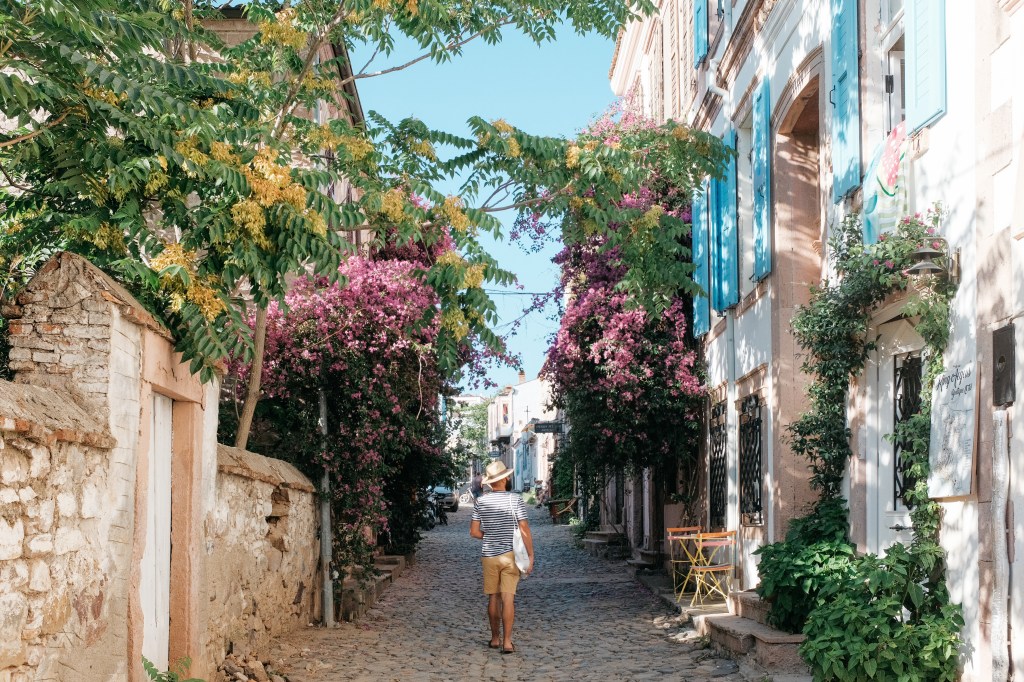
Turkey’s Aegean coast is summer personified. Formerly inhabited by a mostly Greek community, until the population exchange in 1923, which caused a rise in Turkish inhabitants, the historic towns and villages are gaining new life, attracting a new surge of visitors and defining a modern Aegean culture.
The old Greek stone houses are now seeing the opening of boutique hotels, modern restaurants and shops selling handmade crafts. Dishes are prepared with the region’s sun-drenched herbs and produce, olive oil from its many groves and seafood straight from the Aegean fishermen. Wines from local boutique vineyards are uncorked and cocktails are reimagined with local ingredients. Two of the coast’s loveliest spots are the little-known seaside town of Ayvalık, about a 150km north of Izmir and across the Greek island of Lesvos, and the nearby island of Cunda.
Once the center of olive oil production, the chimneys of Ayvalık’s old factories can still be seen while exploring the winding cobblestone alleys that lead past historic churches and old stone houses with colorful window shutters.
Some standouts include the Çınarlı Mosque, formerly the Greek Orthodox church of Ayios Yorgis, built in 1790 with its Ionic columns and cinquefoil windows. The Taksiyarhis Memorial Museum, which was built in 1844 as a Greek Orthodox cathedral, impresses with its very well-preserved original interior of decorated marble columns and vault frescoes.
The old houses of Ayvalık offer an attractive space for ateliers and workshops and so shopping in the town center revolves mostly around handmade goods, whether it’s wood, ceramic or textile.
Near the Taksiyarhis Memorial Museum, in a beautifully renovated historic house with large arched windows, is Moyy Atölye. Founded by Özlem Erol, the organic and sustainable boutique works with local female artisans to promote the revival of Feretiko, a type of traditional hand-knitted hemp cloth from Çamlıhemşin, Rize in Turkey’s Black Sea region. Inside, specially designed garments in natural tones made from Feretiko cloth hang by the windows in the soft light of the afternoon sun.
Near the waterfront, the porcelain studio of Santimetre sits in a renovated neoclassical townhouse. Designer Tulya Madra, who’s also worked in New York City, is known for her hand-cast, glazed dinnerware in colors ranging from Aegean blues to soft pinks, greens and sunny yellows.
Near the sea and surrounded by verdant olive groves and orchards, Ayvalık’s gastronomy is downright Aegean, with fresh and local ingredients adding exceptional flavor to dishes. Inside a renovated old house with baby-blue window frames and shutters, Sofia Ayvalık serves modern Aegean dishes such as pilaf with coriander and artichoke, stuffed dried tomatoes with sour cherries, or celery soup with sage and rosemary all accompanied by local wines. Tables are set up in the alley outside as well as upstairs overlooking the sea.
Located right by the seaside inside a repurposed olive oil factory, Cleto’s is one of Ayvalık’s most popular restaurants. Founded by chef Anacleto Salciccia and his wife Funda Kocadağ Salciccia, the upscale restaurant serves classic Italian food, from seabass carpaccio with lemon mayonnaise to linguine with squid ink and prawns.
For a truly Aegean dining experience inside an olive grove in the village of Küçükköy, Karina Ayvalık is worth the 10-minute drive south of the center. Run by couple Özge and Sinan Sabuncu, it’s their declaration of love for fresh and local ingredients from the Aegean – think fresh seafood pasta or grilled calamari, paired with carefully selected wines from the region.
Olive oil is still central to the area’s identity. Also in the village of Küçükköy, Kürşat Ayvalık, the region’s most respected olive oil producer — recently renovated their mill, adding an additional building to house a museum, shop and restaurant. A family-run business with roots in Crete, siblings Zeynep and Ali Kürşat continue their grandparents’ trade through eco-friendly methods including harvesting olives by hand so as not to bruise the fruit.
At their restaurant, Ayna, a further 15-minute drive northwest of the town center, on the nearby island of Cunda– you can taste simple Aegean dishes such as seabass ceviche with capers and orange zest or rolled phylo dough with local fresh cheese, oregano and wild honey.
In terms of accommodation, Ayvalık’s most unique vacation rentals were created by the architect couple Erdoğan Altındiş and Gabriele Kern-Altındiş who run Manzara, a collection of design-forward homes in both Istanbul and Ayvalık. The couple’s Ayvalık properties consist of five carefully restored stone houses with secluded gardens, sea views and modern interiors with preserved historic architectural details.
Istanbul-based photographer and paper sculpture artist Deniz Yılmaz Akman has spent the last 20 summers at her family home in Ayvalık, capturing the town’s locals and its many hidden corners with her lens. Her favorite places include the renovated Greek houses on 13 Nisan Street, eating the famous Ayvalık toast (with melted cheese, Turkish fermented sausage and pickles) at the cafe Şeytanın Kahvesi, and enjoying fried cuttle fish and mezze at the restaurant Hüsnü Babanın Yeri.
“Ayvalık is a summer getaway that also has the feel of a city,” she says. “I can breathe in the Aegean air and feel history as I walk through the old streets with their historic houses. It’s a place where I can while away [the hours] at a historic café or browse antique shops, but then also taste modern Aegean flavors at a trendy restaurant and sip cocktails at a cool bar.”
“I would recommend that visitors catch a classical music concert at the Ayvalık International Music Academy; try the famous local black mulberry and sour grape juices at Camlı Kahve [café]; try muhallebi [milk pudding] with mastic at Macaron Muhallebicisi and mastic cookies and ice cream at İmren Pastanesi.”
Connected to Ayvalık via a causeway, Cunda Island is a popular summer getaway for domestic tourists who like to spend summer weekends discovering the small island on foot and then dining and drinking at one of the many eateries and bars in and around crowded Hayat Street near the seaside. Some of the favorites here include the modern Italian eatery L’arancia, with its Sicilian-inspired décor and the third wave coffee shop Nona for a cappuccino and a slice of lemon cheesecake. In the evening, cocktail bars such as Orman and Çeşni are filled with young people sipping craft cocktails made from the best of local ingredients such as elderflower, satsuma or linden.
Cups of freshly roasted Turkish coffee are served inside the historic cafe Taş Kahve, also near the waterfront, and the smell of fresh bread and pastries wafts through the nearby street where Cumhuriyet Fırını has been baking since the 1990s.
Outside the main drag, Cunda is more serene. Pomegranate trees hang heavy with fruit in the gardens of more residential townhouses in the labyrinthine alleys that lead uphill and away from the seaside. Residents sweep the fallen leaves off their front steps as the stray dogs nap in the shade of flowering vines.
Getting lost on Cunda leads to discoveries, such as the Cunda Taksiyarhis Rahmi M. Koç Museum inside a renovated Greek Orthodox church with a collection of antique cars, motorcycles and toys. It’s another rescued structure that was once in a state of disrepair but, repurposed, is now full of life.
Photo by Deniz Yılmaz Akman
 Feride Yalav-Heckeroth